Sensex, Nifty, market indices, sectoral indices, BSE, NSE, SEBI-Indian stock market
🎯 Learning Outcome
By the end of this lesson, you’ll understand:
- What a stock market index is
- How the Sensex and Nifty are constructed
- What sectoral indices represent
- Why indices are vital for investors and the economy
🏛️ What Are Market Indices? (Simple Explanation)
A market index shows how a selected group of stocks is performing.
Think of it like a thermometer of the stock market — when it rises, the market is healthy; when it falls, it signals a slowdown.
📌 Why Market Indices Matter:
- Track overall market performance
- Compare your portfolio’s growth with the market
- Help investors find leading sectors and market direction
In India, the two main indices are:
➡️ BSE Sensex
➡️ NSE Nifty 50
📈 BSE Sensex (Sensitive Index)
Launched: 1986
Base Year: 1978–79
Base Value: 100
Companies: 30 leading BSE-listed companies
Type: Free-float market capitalization weighted
🔍 Meaning:
The Sensex represents the performance of India’s top 30 companies.
If the Sensex goes up, investors are confident about the Indian economy.
If it falls, it means fear or uncertainty is growing.
🏢 Example Companies:
Reliance Industries, Infosys, TCS, HDFC Bank, ICICI Bank, HUL, Bharti Airtel, SBI, etc.
📊 NSE Nifty 50
Launched: 1996
Base Year: 1995
Base Value: 1000
Companies: 50 top NSE-listed companies
Coverage: Represents ~65% of total market capitalization
💡 What It Means:
The Nifty 50 reflects India’s overall corporate health — across 13 sectors like banking, IT, auto, FMCG, and energy.
🧮 Formula (simplified):
Index Value=Current Market Cap of ConstituentsBase Market Cap×100\text{Index Value} = \frac{\text{Current Market Cap of Constituents}}{\text{Base Market Cap}} \times 100Index Value=Base Market CapCurrent Market Cap of Constituentsx100
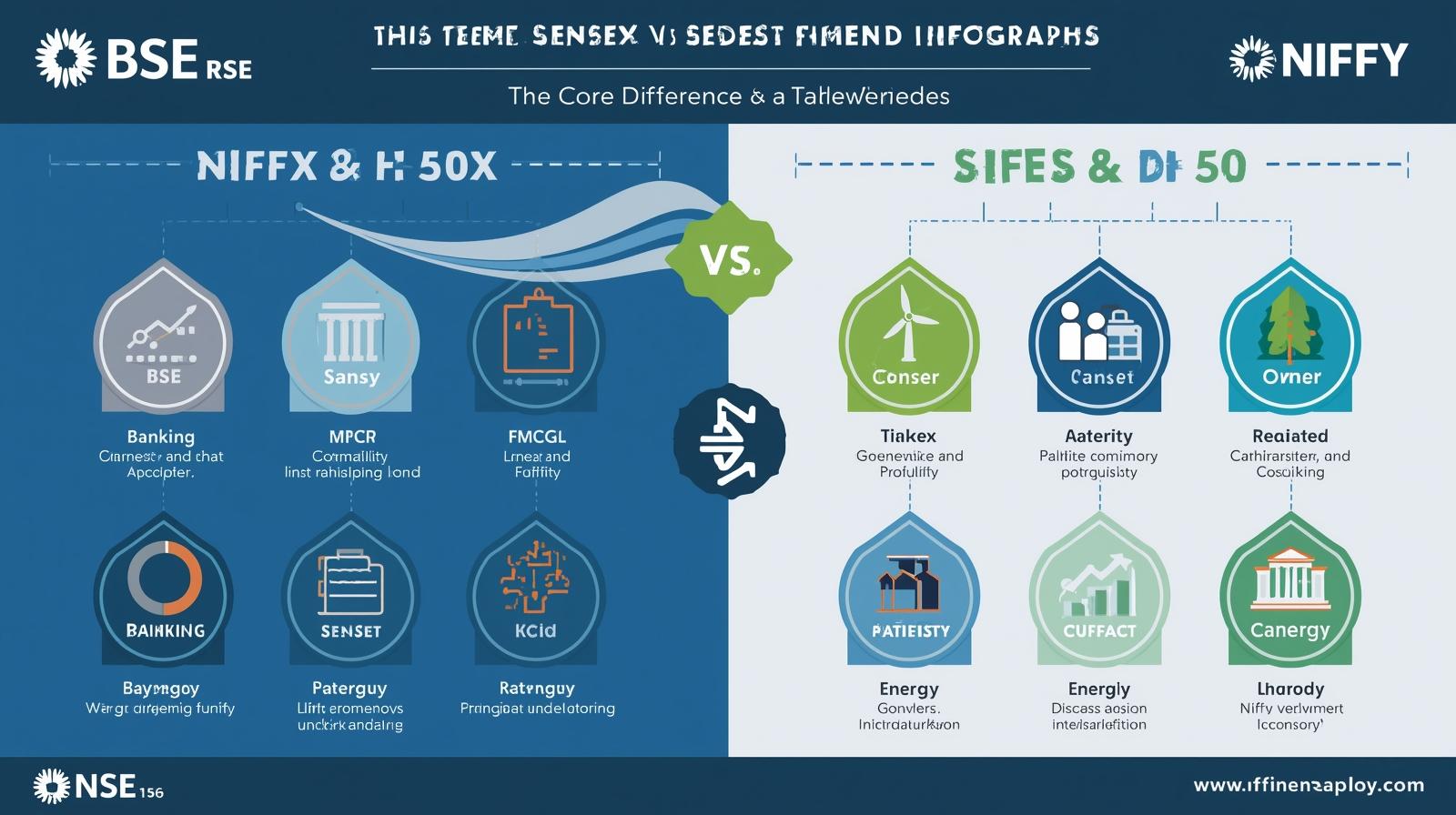
⚖️ Sensex vs Nifty – Key Differences
| Feature | Sensex (BSE) | Nifty 50 (NSE) |
|---|---|---|
| Launch Year | 1986 | 1996 |
| Base Year | 1978–79 | 1995 |
| Base Value | 100 | 1000 |
| Companies | 30 | 50 |
| Type | Free-float weighted | Free-float weighted |
| Exchange | Bombay Stock Exchange | National Stock Exchange |
| Sector Coverage | ~10 sectors | ~13 sectors |
👉 In short: Sensex = 30 elite companies; Nifty = 50 diversified leaders.
🏭 Sectoral Indices in India
Apart from overall indices, the NSE and BSE track specific sectors to show how industries are performing.
| Sector | NSE Index |
|---|---|
| Banking | Nifty Bank |
| Information Technology | Nifty IT |
| Pharma | Nifty Pharma |
| FMCG | Nifty FMCG |
| Energy | Nifty Energy |
| Infrastructure | Nifty Infra |
| Auto | Nifty Auto |
| Metal | Nifty Metal |
📌 Example:
If Nifty IT goes up by 2%, it means most IT companies (like Infosys or TCS) are doing well.
More Articles You Might Find Useful:
- Q2 FY2025-26: Indian quarterly results 2025 Trend Report
- Netflix Announces 10-for-1 Stock Split: Here’s What Investors Need to Know
- Top 5 Dividend Announcements in India: Infosys, HUL, Coal India, HCL Tech, and Sundram Fasteners Reward Shareholders
- Reliance Jio–Google Partnership: 18-Month Free Gemini Pro Access Set to Boost AI Adoption in India
- Open Demat Account (M-Stock)
💰 Why Market Indices Are Important
📈 For Investors:
- Show market trend direction
- Used to measure portfolio performance
- Base for index mutual funds & ETFs
💼 For Economists:
- Reflect economic sentiment
- Help in policy decision-making
🏢 For Companies:
- Being included in major indices boosts visibility and credibility
- Attracts institutional & foreign investors
🧠 Types of Indices in India
- Broad Market Indices: Sensex, Nifty 50
- Sectoral Indices: Nifty Bank, Nifty IT, Nifty Pharma
- Thematic Indices: Nifty ESG, Nifty Consumption
- Strategy Indices: Nifty Low Volatility, Nifty Alpha
- Debt Indices: Represent government or corporate bonds
📘 Real Example of Market Movement
- If oil prices rise → Nifty Energy may gain
- If IT results are strong → Nifty IT surges
- If interest rates increase → Nifty Bank may decline
Tracking these gives traders a snapshot of sector strength and helps forecast trends.
📋 Summary Table
| Term | Meaning |
|---|---|
| Sensex | Index of 30 top companies on BSE |
| Nifty 50 | Index of 50 leading companies on NSE |
| Sectoral Indices | Track industry-specific performance |
| Importance | Reflects market health and investor sentiment |
Regulatory Oversight – SEBI
While SEBI (Securities and Exchange Board of India) does not directly manage these indices, it:
- Regulates the exchanges (BSE & NSE) that own them.
- Ensures transparency, fair calculation methods, and no manipulation.
- Can intervene if index composition or operation violates market-integrity norms.
So, SEBI = Regulator,
BSE / NSE = Index Owners & Managers.
❓ FAQs on Market Indices:
Q1. What is the difference between Sensex and Nifty?
Sensex tracks 30 BSE companies, while Nifty covers 50 NSE companies. Both measure market performance but on different exchanges.
Q2. Why are sectoral indices important?
They show which sectors are performing best — helping investors choose where to invest.
Q3. What happens when Sensex rises?
It indicates growing confidence and bullish sentiment in the Indian economy.
Q4. Can investors directly invest in Sensex or Nifty?
Not directly, but you can invest through index funds or ETFs that track these indices.
Q5. Which index is broader — Sensex or Nifty?
Nifty 50 is broader because it includes more companies and sectors.
💬 Reader Engagement Section
👉 Do you own any shares yet?
💡 Want to learn how companies bring shares to the market?
Course Introduction
🌟 Coming Up in Lesson 8
👉 “ Lesson 8: Types of Stocks “
Learning Outcome: Large, mid, small cap, penny.
“
In the next lesson, you will learn:
Learn how companies issue their shares to the public through the Initial Public Offering (IPO) process. Understand each step — from company approval and SEBI registration to share allotment and listing on stock exchanges — in this beginner-friendly lesson on how shares enter the stock market.
Open Demat Account
by Mirae Asset (m,Stock)

-
Top 10 Stocks to Watch: Q1 Earnings Momentum & Sectoral Breakouts (August 3, 2026): Weekly Market Intelligence: 10 Stocks to Watch
Dalal Street is stepping into August 2026 with a strong stock-specific bias driven by the Q1 FY27 earnings season. While elevated crude oil prices and global rate decisions keep broad-index rallies in check, institutional capital is actively rotating into power grid equipment, non-ferrous metals, automotive outperformance, and high-margin private banks. Technically, the Nifty 50 faces…
-
Trading Alert: Indian Stock Market Holidays on March 31 and Good Friday 2026
Stock Market Holidays 2026| NSE Holiday List| BSE Holidays| Mahavir Jayanti 2026| Good Friday 2026| Trading Calendar India| Share Market News| NSE Closed Dates| Indian Stock Market. Critical Dates & Holiday Schedule Event Date Day Market Status Mahavir Jayanti March 31, 2026 Tuesday Closed Annual Bank Closing April 01, 2026 Wednesday Open (Settlement Holiday) Good…
-
Nifty 50 and Sensex Post-Bloodbath Analysis: Recovery or Trap?
Nifty 50 Prediction Tomorrow| Sensex Analysis March 2026| Indian Stock Market Recovery| Stock Market Bloodbath Reasons The Indian stock market recently faced a “Black Monday” on March 23, 2026, where the Sensex plunged nearly 2,000 points and the Nifty 50 tumbled over 600 points. However, the session on Tuesday, March 24, has brought a sigh…