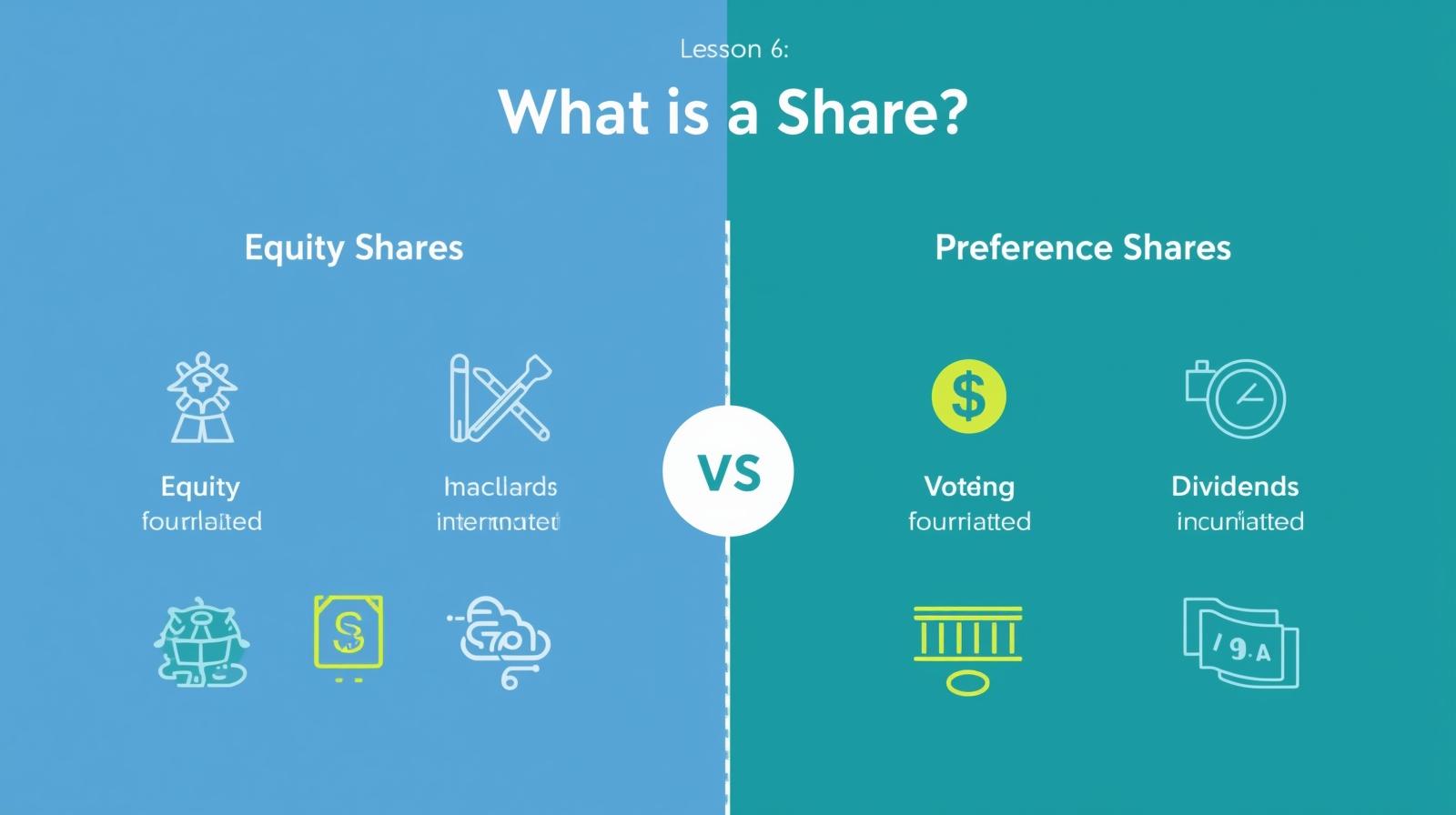
🧩 What is a Share?
(Module 2: Basics of Stocks)
A share is a unit of ownership in a company. When you buy a share, you become a part-owner of that business. It gives you the right to participate in profits, dividends, and decision-making through voting rights.
📘 Understanding What a Share Is?
Every company divides its total capital into small units called shares.
Buying one share means you own a portion of that company’s ownership.
📊 Example:
If a company has 1,00,000 total shares and you buy 1,000, you own 1% of the company.
Owning shares makes you a shareholder, and you benefit when:
- The company earns profits (through dividends).
- The share price increases in the market.
💡 Why Companies Issue Shares
Companies need funds for growth, expansion, and innovation.
Instead of borrowing from banks, they raise money through issuing shares to the public.
- The first time a company offers its shares = Initial Public Offering (IPO).
- After that, those shares trade between investors on stock exchanges like NSE or BSE.
This allows investors to buy, sell, and profit from share price movements.
💰 Types of Shares
🟦 1. Equity Shares
- Represent real ownership in the company.
- Provide voting rights and dividend income.
- Returns depend on company performance and market conditions.
- High risk, but also high return potential.
📈 Example: Infosys or TCS shares rising due to strong results.
🟩 2. Preference Shares
- Have fixed dividend payouts.
- Usually no voting rights.
- Preference shareholders are paid before equity holders in case of liquidation.
- Safer but limited profit potential.
⚖️ Key Share Market Terms
| Term | Meaning | Example |
|---|---|---|
| Face Value (FV) | The original nominal value of a share. | ₹10 |
| Market Value (MV) | The price at which the share trades in the market. | ₹1,200 |
| Dividend | Profit shared by the company with shareholders. | ₹4 per ₹10 share |
| Book Value (BV) | Company’s net asset value per share. | Depends on balance sheet |
📈 How Share Prices Move
Share prices move due to:
- Company earnings
- Market sentiment
- Economic news
- Global trends
- Demand & supply among investors
A good company report can push the stock price up, while weak results may pull it down.
🚀 Why Shares Matter for Investors
Owning shares helps investors:
- Build long-term wealth.
- Earn passive income through dividends.
- Beat inflation compared to fixed deposits.
- Participate in India’s economic growth journey.
📊 Example:
If Reliance share was ₹10 in the 1980s and is now above ₹2,500 — early investors multiplied wealth over decades!
🧠 Quick Recap
- A share = unit of company ownership.
- Equity shares give ownership and voting rights.
- Preference shares give priority dividends.
- Face value ≠ market value.
- Long-term holding can generate massive wealth.
🧩 Mini Quiz (Engage & Learn)
1️⃣ What does owning a share mean?
a) Lending money to the company
b) Owning part of the company ✅
c) Getting a fixed return
2️⃣ Which shareholders get dividends first?
a) Equity shareholders
b) Preference shareholders ✅
c) Directors
3️⃣ What is Face Value?
a) Market price
b) Original issue value ✅
c) Dividend rate
(💬 Share your answers in the comments below!)
💬 Reader Engagement Section
👉 Do you own any shares yet?
💡 Want to learn how companies bring shares to the market?
Course Introduction
🌟 Coming Up in Lesson 7
👉 “Lesson 7 – How Shares Are Issued (IPO Process)“
In the next lesson, you will learn:
Learn how companies issue their shares to the public through the Initial Public Offering (IPO) process. Understand each step — from company approval and SEBI registration to share allotment and listing on stock exchanges — in this beginner-friendly lesson on how shares enter the stock market.
Open Demat Account
by Mirae Asset (m,Stock)

-
Top 10 Stocks to Watch: Q1 Earnings Momentum & Sectoral Breakouts (August 3, 2026): Weekly Market Intelligence: 10 Stocks to Watch
Dalal Street is stepping into August 2026 with a strong stock-specific bias driven by the Q1 FY27 earnings season. While elevated crude oil prices and global rate decisions keep broad-index rallies in check, institutional capital is actively rotating into power grid equipment, non-ferrous metals, automotive outperformance, and high-margin private banks. Technically, the Nifty 50 faces…
-
Trading Alert: Indian Stock Market Holidays on March 31 and Good Friday 2026
Stock Market Holidays 2026| NSE Holiday List| BSE Holidays| Mahavir Jayanti 2026| Good Friday 2026| Trading Calendar India| Share Market News| NSE Closed Dates| Indian Stock Market. Critical Dates & Holiday Schedule Event Date Day Market Status Mahavir Jayanti March 31, 2026 Tuesday Closed Annual Bank Closing April 01, 2026 Wednesday Open (Settlement Holiday) Good…
-
Nifty 50 and Sensex Post-Bloodbath Analysis: Recovery or Trap?
Nifty 50 Prediction Tomorrow| Sensex Analysis March 2026| Indian Stock Market Recovery| Stock Market Bloodbath Reasons The Indian stock market recently faced a “Black Monday” on March 23, 2026, where the Sensex plunged nearly 2,000 points and the Nifty 50 tumbled over 600 points. However, the session on Tuesday, March 24, has brought a sigh…