🔥 Introduction:
Imagine you are Priya, a young school teacher saving money every month. You hear about an upcoming IPO of a company making electric vehicles, founded by Ramesh. The buzz is everywhere — news channels, social media, financial blogs. Friends are excited, saying, “This stock might double on listing!”
But what is an IPO really? Why does Ramesh want to sell part of his company to strangers? And most importantly — should Priya risk her savings?
This is exactly what Lesson 4 of our Stock Market Course will answer. We will dive into IPOs (Initial Public Offerings), the primary market, and the fascinating journey of how a private company becomes publicly listed on stock exchanges like NSE & BSE. By the end of this lesson, you will not only understand IPOs but also know how to apply, what to expect, and how to separate hype from reality.
Quick Recap – Lesson 3: Types of Financial Markets:
📖 What is an IPO?
An IPO (Initial Public Offering) is when a private company offers its shares to the public for the very first time. It is like a grand entry ticket for retail investors into a company’s growth story.
- Before IPO: Only founders, venture capitalists, and a few early investors own shares.
- After IPO: Anyone with a Demat account can become a shareholder.
👉 Example: When Infosys came out with its IPO in 1993, investors who subscribed at a few hundred rupees have seen massive wealth creation. Today Infosys is one of India’s most respected companies.
But not every IPO becomes a goldmine. Some IPOs like Paytm (2021) disappointed investors after listing.
Thus, IPOs can be exciting but also carry risks and volatility.
💡 Why Do Companies Launch IPOs?
Companies go public mainly for:
- Raising Capital for Growth
- Ramesh’s EV company needs ₹500 crore to expand factories.
- IPO provides access to public money.
- Providing Exit to Early Investors
- Venture capitalists or private equity firms can sell their stake.
- Enhancing Visibility & Credibility
- A listed company enjoys more trust from customers, banks, and partners.
- Employee Stock Options (ESOPs)
- IPO enables employees to sell their stock options in the market.
👉 Case Example:
- Zomato IPO (2021) raised ₹9,375 crore and gave early exit to investors like Info Edge.
- It also created huge brand visibility — every retail investor suddenly knew Zomato’s growth story.
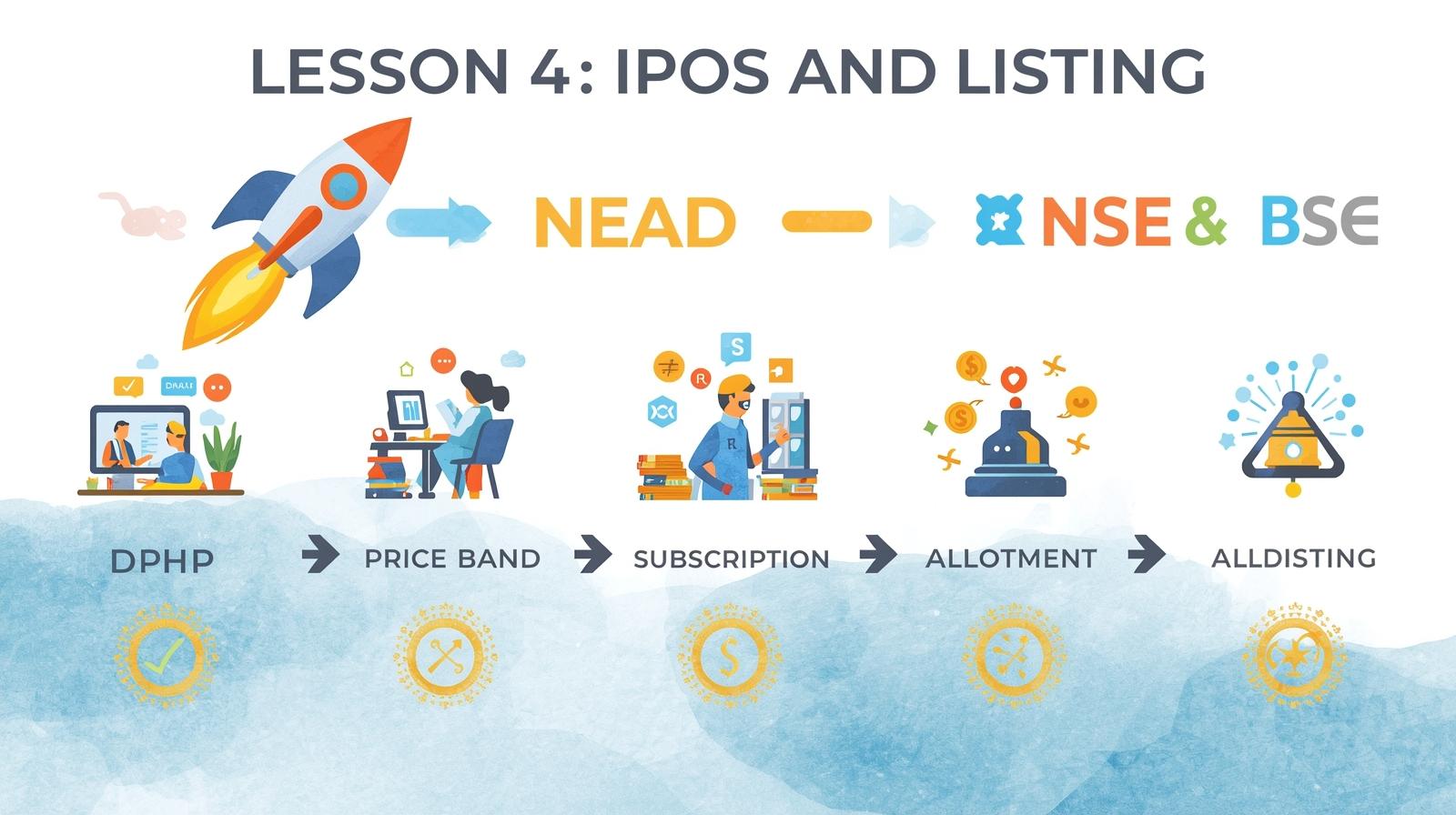
📊 The IPO Process in India
| Step | Action | Example |
|---|---|---|
| 1 | File Draft Red Herring Prospectus (DRHP) with SEBI | Ramesh’s EV company submits details of business, risks, and finances. |
| 2 | SEBI Review & Approval | Ensures transparency and compliance. |
| 3 | Price Band & Lot Size Decided | ₹100–₹105 per share, 1 lot = 150 shares. |
| 4 | Subscription Window (3–5 days) | Investors bid for shares. |
| 5 | Book-Building & Demand Analysis | If demand > supply, IPO oversubscribed. |
| 6 | Allotment & Refunds | Shares credited to successful applicants. Others get refunds. |
| 7 | Listing on NSE & BSE | Trading begins, price depends on demand & sentiment. |
👉 Example: Nykaa IPO (2021) was oversubscribed 82 times, leading to strong listing gains.
🏦 Primary Market vs Secondary Market:
- Primary Market → Fresh capital raising via IPO.
- Secondary Market → Trading among investors post listing.
Example:
- Priya applies for 1 lot of Ramesh’s EV IPO.
- If allotted, she owns 150 shares.
- On listing, she can sell them in the secondary market to another investor.
📌 Real-Life IPO Stories:
✅ Success Stories
- Infosys (1993) – Early investors made fortunes.
- Zomato (2021) – Created massive retail interest, gave short-term gains.
❌ Disappointing IPOs
- Paytm (2021) – Listed at a discount, lost over 70% of its IPO value later.
- Reliance Power (2008) – India’s biggest IPO at that time, but stock crashed after listing.
👉 Lesson: Not all IPOs are profitable. Research matters more than hype.
👩💻 How Retail Investors Can Apply for IPOs?:
Ways to apply:
- ASBA (Application Supported by Blocked Amount) – Via net banking.
- UPI Mandate – Most popular method.
Requirements:
- Demat Account
- PAN Card
- Linked Bank Account
Tips for Allotment Success:
- Apply in retail category
- Avoid last-minute rush
- Apply at cut-off price
⚖️ Risks vs Rewards:
Rewards:
- Listing gains
- Early entry into high-growth companies
- Long-term wealth creation
Risks:
- Overvaluation
- Volatility on listing day
- Poor financial fundamentals
❌ Myths vs ✔ Reality (250+ words)
- ❌ Every IPO is profitable → ✔ Some lose value after listing
- ❌ IPO is only for big investors → ✔ Retail investors can also participate
- ❌ Apply in all IPOs → ✔ Choose wisely after research
🙋♀️ FAQs:
Q1: What is the minimum investment in an IPO?
A: Usually one lot (₹12,000–₹15,000).
Q2: Can I sell shares on the listing day?
A: Yes, you can sell in the secondary market.
Q3: How do I know if I got IPO allotment?
A: Check status on NSE/BSE IPO portal.
Q4: Are IPOs risk-free?
A: No, they carry both reward and risk.
Q5: Which was India’s largest IPO?
A: LIC IPO in 2022.
🎯 Key Takeaways:
- IPO = First public offering of shares
- Primary → IPO, Secondary → Trading
- Not all IPOs give profit, research is key
- Apply via ASBA/UPI with Demat account
Course Introduction
🌟 Coming Up in Lesson 5
👉 “Next we should work on Lesson 5: Market Participants
Understand the roles of Retail Investors, Foreign Institutional Investors (FIIs), and Domestic Institutional Investors (DIIs) in the stock market.
Mark your calendar – Lesson 4 is on the way with exciting insights on IPOs.🚀
Open Demat Account
by Mirae Asset (m,Stock)
-
Top 10 Stocks to Watch: Q1 Earnings Momentum & Sectoral Breakouts (August 3, 2026): Weekly Market Intelligence: 10 Stocks to Watch
Dalal Street is stepping into August 2026 with a strong stock-specific bias driven by the Q1 FY27 earnings season. While elevated crude oil prices and global rate decisions keep broad-index rallies in check, institutional capital is actively rotating into power grid equipment, non-ferrous metals, automotive outperformance, and high-margin private banks. Technically, the Nifty 50 faces…
-
Trading Alert: Indian Stock Market Holidays on March 31 and Good Friday 2026
Stock Market Holidays 2026| NSE Holiday List| BSE Holidays| Mahavir Jayanti 2026| Good Friday 2026| Trading Calendar India| Share Market News| NSE Closed Dates| Indian Stock Market. Critical Dates & Holiday Schedule Event Date Day Market Status Mahavir Jayanti March 31, 2026 Tuesday Closed Annual Bank Closing April 01, 2026 Wednesday Open (Settlement Holiday) Good…
-
Nifty 50 and Sensex Post-Bloodbath Analysis: Recovery or Trap?
Nifty 50 Prediction Tomorrow| Sensex Analysis March 2026| Indian Stock Market Recovery| Stock Market Bloodbath Reasons The Indian stock market recently faced a “Black Monday” on March 23, 2026, where the Sensex plunged nearly 2,000 points and the Nifty 50 tumbled over 600 points. However, the session on Tuesday, March 24, has brought a sigh…
-
Top 10 Stocks to Watch: Q1 Earnings Momentum & Sectoral Breakouts (August 3, 2026): Weekly Market Intelligence: 10 Stocks to Watch
Dalal Street is stepping into August 2026 with a strong stock-specific bias driven by the Q1 FY27 earnings season. While elevated crude oil prices and global rate decisions keep broad-index rallies in check, institutional capital is actively rotating into power grid equipment, non-ferrous metals, automotive outperformance, and high-margin private banks. Technically, the Nifty 50 faces…
-
Trading Alert: Indian Stock Market Holidays on March 31 and Good Friday 2026
Stock Market Holidays 2026| NSE Holiday List| BSE Holidays| Mahavir Jayanti 2026| Good Friday 2026| Trading Calendar India| Share Market News| NSE Closed Dates| Indian Stock Market. Critical Dates & Holiday Schedule Event Date Day Market Status Mahavir Jayanti March 31, 2026 Tuesday Closed Annual Bank Closing April 01, 2026 Wednesday Open (Settlement Holiday) Good…
-
Nifty 50 and Sensex Post-Bloodbath Analysis: Recovery or Trap?
Nifty 50 Prediction Tomorrow| Sensex Analysis March 2026| Indian Stock Market Recovery| Stock Market Bloodbath Reasons The Indian stock market recently faced a “Black Monday” on March 23, 2026, where the Sensex plunged nearly 2,000 points and the Nifty 50 tumbled over 600 points. However, the session on Tuesday, March 24, has brought a sigh…