Demat Account| Trading Account| Bank Account for Investment| Stock Market for Beginners| How to Open Demat Account| Difference Between Demat and Trading| Investment Accounts India| Broker Safety| Stock Market Course
Introduction of the Lesson
Stock market education is incomplete until a learner fully understands Demat, Trading, and Bank Accounts — the three most important elements required to begin investing. Even the smartest investors, financial analysts, and traders cannot buy or sell a single share in the Indian stock market without the support of these three accounts working in a precise sequence. In earlier lessons, we studied how the market functions and how shares are priced. In this lesson, we will move to the practical world of investing and learn how to open and operate investment accounts safely and efficiently.
A few years ago, investors used to store physical share certificates — bulky documents that required verification and could get lost, stolen or damaged. Today, technology has fully transformed the investment landscape. Shares now exist only in electronic format and are stored securely inside a Demat Account. To buy or sell those shares on NSE or BSE, an investor uses a Trading Account. And to fund purchases or receive profits after selling, every investor must connect a Bank Account.
This lesson explains the function of each account, risks, charges, safety guidelines, how to choose a broker, how to avoid common mistakes, how to protect investments in case of a cyber scam, and what happens if a broker shuts down. Whether you are a beginner planning your first SIP, an intermediate investor exploring IPOs and ETFs, or a future trader looking at intraday, this lesson will make the foundation rock solid.
By the end of Lesson 11, you will not only understand how the three accounts work individually — but you will also have a crystal-clear understanding of the interlink between them. Once this lesson is mastered, opening an account and starting investments will become easy, confident and mistake-free.
About Demat & Trading Account
📌 What is a Demat Account?
A Demat Account (Dematerialised Account) is an electronic storage locker where all your securities are kept digitally. Just like a bank account stores money, a Demat account stores:
- Equity shares
- ETFs
- Bonds
- Debentures
- REITs & InvITs
- Government securities
- Mutual fund units (optional)
- IPO allotments
A Demat account does not help you buy or sell — it only stores your holdings. It is a permanent archive of all ownership investments linked to your PAN. In India, Demat accounts operate under two national depositories:
🔹 CDSL (Central Depository Services Limited)
🔹 NSDL (National Securities Depository Limited)
Your broker (Zerodha, Angel One, Upstox, ICICI Direct etc.) is only a Depository Participant (DP) — not the owner of your holdings. All your shares are safely stored with CDSL/NSDL and not the broker.
📌 What is a Trading Account?
A Trading Account is the interface that allows you to place buy and sell orders on the stock exchanges (NSE and BSE). It acts as a bridge between your bank account and Demat account. (mStock)
When you buy shares:
Bank Account → Trading Account → Shares deposited in Demat (mStock)
When you sell shares:
Demat Account → Trading Account → Money deposited in Bank Account
Without a Trading Account, you cannot buy or sell shares even if your Demat account exists.
📌 Difference Between Demat and Trading (mStock)
| Feature | Demat Account (mStock) | Trading Account (mStock) |
|---|---|---|
| Purpose | Store shares and securities | Buy and sell shares |
| Works like | A digital locker | A transaction counter |
| Holding | Yes | No |
| Risk | Market value fluctuation | Risk of over-trading |
| Mandatory | Yes | Yes |
Memory Trick 💡
Demat = Locker, Trading = Shop Counter
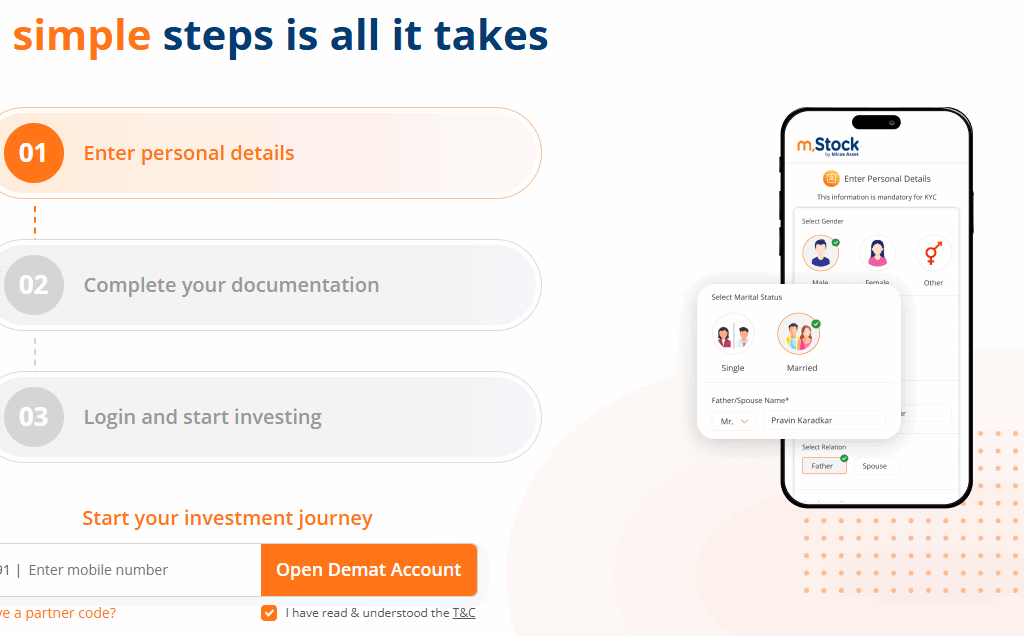
📌 Step-by-Step Process to Open Both Accounts
- Choose a broker (mStock)
- Register online
- Submit PAN, Aadhaar, bank details & signature
- Complete IPV (In-Person Verification)
- Sign e-Agreements
- Link bank account
- Activate Demat & Trading login credentials
- Set TPIN and 2FA security
- Add funds and begin investing
📌 Charges
| Category | Typical Range |
|---|---|
| Account Opening | ₹0 – ₹1,000 |
| AMC (Annual Maintenance) | ₹0 – ₹700 |
| Brokerage | ₹0 – ₹20 per order (discount brokers) |
| DP Charges (on Sell) | ₹10 – ₹30 |
📌 Why Every Investor Must Have a Demat Account (mStock)
- Mandatory for IPO allotments
- Stores digital proof of ownership
- Helps claim tax benefits & dividends
- Single account for lifetime investment tracking
🚨 Common Mistakes Beginners Should Avoid
Many new investors lose money not because of the market, but because of basic misunderstandings and avoidable mistakes. Before starting your first trade or SIP, avoid the following:
❌ 1. Opening a Demat & Trading Account Without Research
Many beginners open an account randomly without comparing:
- Brokerage charges
- AMC charges
- Platform reliability
- Support quality
👉 Recommended Solution: Open a Demat & Trading account with a trusted, low-cost and user-friendly broker.
💡 Suggested Broker for Beginners: mStock by Mirae Asset – Zero brokerage on delivery & ultra-low cost trading.
🔗 Open Account with mStock: Click Here
❌ 2. Believing Tips, Telegram Calls & Rumours
New investors often follow:
- WhatsApp/Telegram “sure shot” tips
- Social media hype
- Unverified stock recommendations
📌 Always invest based on research, fundamentals and risk appetite — not on hype.
❌ 3. Trading Without Understanding the Platform
Many users click BUY / SELL without knowing:
- Order type (Market / Limit / SL / SL-M)
- CNC & MIS
- Intraday vs Delivery
- Margin rules
📌 Practice in virtual mode or start with small amounts until you understand the platform.
❌ 4. Not Enabling Security Features
Some users forget to activate:
- TPIN
- 2FA authentication
- Email & SMS alerts
📌 Security First! Enable all protections to avoid fraud.
❌ 5. Over-Trading Because of Excitement
New investors feel “more trades means more profit” — which is wrong.
Over-trading leads to:
- Losses due to brokerage & charges
- Emotional stress
- Impulsive decisions
📌 Trade only when there is a clear plan & logic.
❌ 6. Not Adding Nominee
Many investors ignore nominee details in:
- Bank account
- Demat account
- Trading account
📌 Always add a nominee to protect your family.
❌ 7. No Tracking of Investments
Beginners forget:
- How much they invested
- How much they withdrew
- Profit/loss percentage
📌 Maintain a simple tracking sheet or track using broker dashboard.
❌ 8. Investing Emergency Money
Using:
- Rent money
- School fees
- Household expenses
for stock trading is a big mistake.
📌 Only invest surplus money, not survival money.
⭐ Recommended First Step for Beginners
Open a safe, low-cost & beginner-friendly Demat + Trading account before investing.
👉 Recommended Broker for Beginners: mStock by Mirae Asset
Ultra-low charges | low brokerage on delivery | Reliable platform
🔗 Affiliate Account Opening Link: mStock: Click Here
All Additional Details (Safety, Tips, Platform Checklist etc.)
🛡️ Security Tips for Demat & Trading Accounts
- Create strong passwords
- Enable TPIN for selling shares
- Always check SMS/email alerts from CDSL
- Do not share OTP and login credentials
- Use registered mobile & email only
🧠 How to Choose the Right Broker
| Type | Advantages | Examples |
|---|---|---|
| Discount Brokers mStock: Click Here | Cheap brokerage & fast platforms | Zerodha, Groww, Upstox, Angel One, mStock: Click Here |
| Full-Service Brokers | Research reports & advisory | ICICI Direct, Kotak, HDFC Securities |
Beginners usually benefit from discount brokers because of low charges.
Bank Account
A Bank Account is needed to deposit funds for investing and receive profits after selling shares.
It must be linked with the trading account.
Money does not move from Demat to Bank nor from Bank to Demat — it always moves through Trading Account.
Charges in Bank
Bank charges vary depending on:
- Debit card usage
- SMS alert charges
- Fund transfer (NEFT/RTGS/IMPS)
- Minimum balance requirement
Necessity of Bank Account
Even though it is technically possible to maintain one bank account for everything, experts recommend keeping a separate account only for investing, because:
- Better tracking of investments
- Improves financial discipline
- Reduces risk of fraud
- Simplifies tax filing
- Protects salary/household funds from market risk
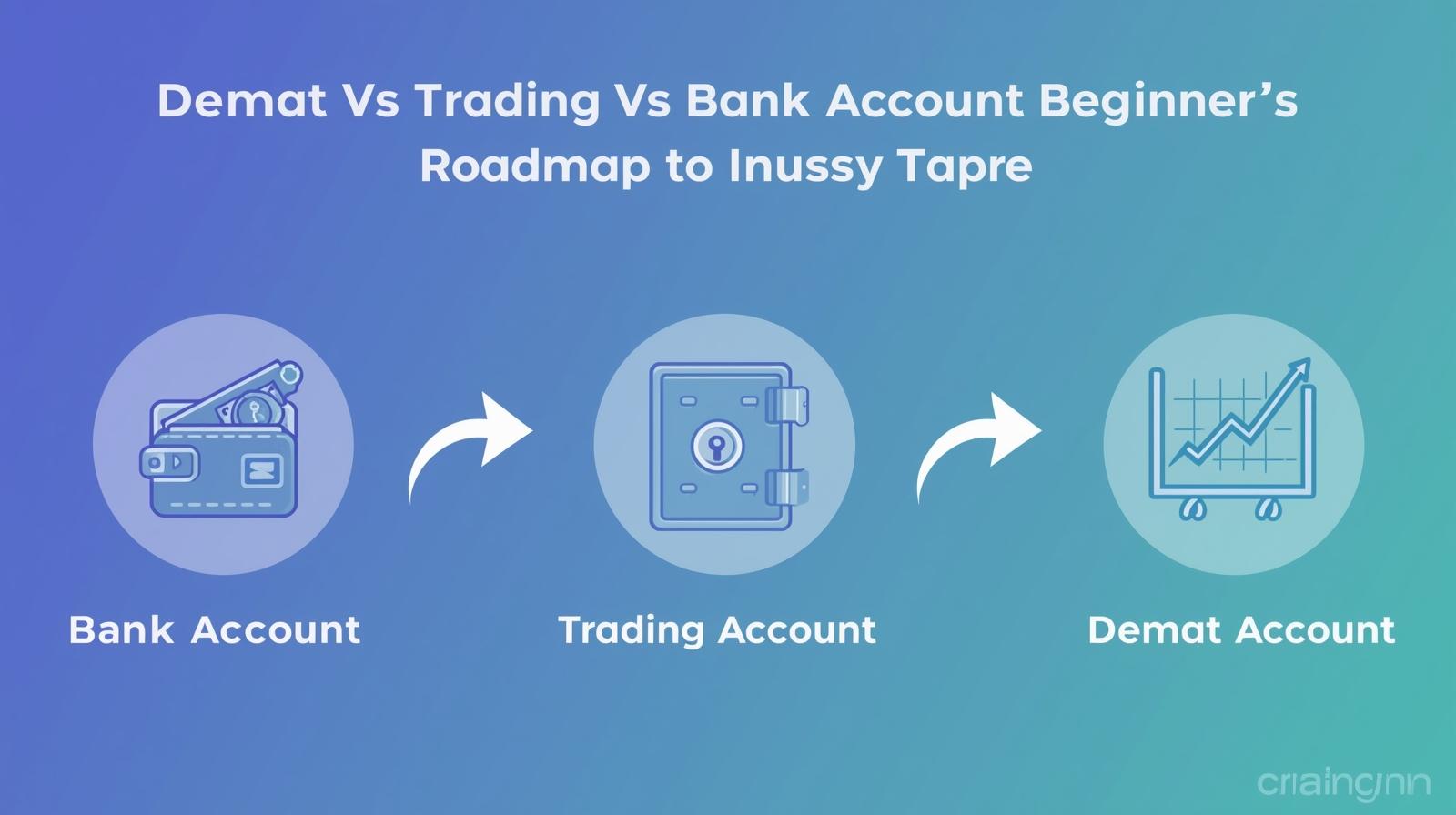
Interlink Between All Three
🔄 Money & Shares Flow
When Buying:
Bank → Trading → Demat (shares stored)
When Selling:
Demat → Trading → Bank (money credited)
Visual Representation
💰 Bank = Money Wallet
🛒 Trading = Buy/Sell Counter
🔒 Demat = Storage Locker
All three are equally important and act as ONE system.
Frequently Asked Questions:
| Question | Answer |
|---|---|
| Is Demat compulsory to invest? | Yes, shares cannot be stored without Demat. |
| Is Trading compulsory for long-term holding? | Yes, because buying itself requires trading. |
| Can I have multiple Demat Accounts? | Yes, but each must be linked with PAN. |
| Is Demat safe if broker shuts down? | Yes, shares stay with CDSL/NSDL, not the broker. |
| Can I close Demat later? | Yes, anytime after clearing holdings. |
Self-Awareness Section
Before starting investments, every beginner should think about:
✔ Investment objective (Wealth creation / Short term trading / Retirement)
✔ Risk appetite (Low / Medium / High)
✔ Emergency fund availability
✔ Ability to handle market fluctuations emotionally
✔ Consistency in monthly investing plan
Self-awareness protects investors from panic selling, over-trading and emotional decisions.
If Broker Shuts Down
A very common fear among beginners is:
“What if my broker collapses or runs away — will I lose my shares?”
The answer is NO.
- Shares are stored in CDSL or NSDL
- Broker only provides platform access
- Even if platform shuts down → holdings remain 100% safe
- You can transfer shares to another broker anytime using CDSL E-DIS
Funds kept with a broker are also protected through:
- Client-fund segregation rules
- SEBI & Exchange monitoring
Before starting investment, ensure:
| Requirement | Must Be |
|---|---|
| PAN | Linked with Aadhaar |
| Bank Account | Same name as PAN |
| Nominee | Added in Bank + Demat + Trading |
| Mobile Number | Verified |
| Verified | |
| TPIN | Enabled |
| 2FA | Enabled |
| Password | Strong |
If any mismatch exists (name/signature/address), it must be fixed before investment.
Conclusion
A Demat mStock: Click Here and Trading account along with a Bank account form the foundation of investing in the Indian stock market. Demat stores shares, Trading executes transactions, and Bank supports fund settlement. When beginners understand how these three work together, investing becomes smooth, safe, and stress-free. With proper security, controlled emotions, smart broker selection, and awareness of charges, anyone can participate in the stock market confidently.
⭐ Key Takeaway
Every investor needs a Demat + Trading + Bank Account — and understanding the interlink between them is the first real step to financial freedom.
Demat Account| Trading Account| Bank Account for Investment| Stock Market for Beginners| How to Open Demat Account| Difference Between Demat and Trading| Investment Accounts India| Broker Safety| Stock Market Course
Also Visit:
Lesson 10: Dividends & Earnings Explained | Stock Market Course
45 Weeks. 45 Lessons. From Basics to Advanced – Master Stock Market Investing in Less than 1 Year.
Lesson 1: What is a Stock Market? Beginner’s Guide to Understanding Shares & Trading
Course Introduction
🌟 Coming Up in Lesson 12 :Order Types
Learning Outcome: Market order, limit, stop-loss, GTT.
Key Takeaway: Using right order protects from risk.
You Can visit:
Open Demat Account
by Mirae Asset (m,Stock)

-
The Great Lockdown: Iran’s Strategic Halt of Food Exports in 2026
Iran Food Export Ban| Iran Agricultural Halt 2026| Middle East Food Security Crisis| Iran Domestic Supply Protection| Iran Food Export…
-
Iran-Israel War: Unpacking “Operation Lion’s Roar” and its Ripple Effect on Global Markets – A Deep Dive for Indian Investors
Iran-Israel War Market Impact| Operation Lion’s Roar update| Effect of Iran war on Nifty 50| Crude oil price surge 2026|…
-
The Tariff Tussle: Decoding the Legal Challenge to Executive Trade Power
Supreme Court| Tariffs| Trade War 2026| Donald Trump| IEEPA| Section 301| US Economy| Import Duties| Constitutional Law| Reciprocal Trade Act…
-
The 2025-26 Market Journey: From All-Time Highs to the “Retail Trap” Panic
Indian Stock Market Performance 2025-26| Nifty 50 Returns FY26| Why is Market Falling Feb 2026| Hold or Sell Indian Stocks|…
-
Indian Stock Market Update Feb 20: Nifty Reclaims 25,550, Sensex Jumps 316 Pts Amid Global Cues
Indian Stock Market Update Feb 20| Nifty 50 today| Sensex closing| Top gainers and losers Market Snapshot: The Bulls Fight…
-
Indian Stock Market Today: Bulls Charge Ahead as Sensex and Nifty Rally on Banking & IT Strength
# Indian Stock Market Today: Sensex and Nifty Close Higher Amid Broad-Based Buying ## Indian Stock Market Report – Updated…