Stock Market Holidays 2026| NSE Holiday List| BSE Holidays| Mahavir Jayanti 2026| Good Friday 2026| Trading Calendar India| Share Market News| NSE Closed Dates| Indian Stock Market.
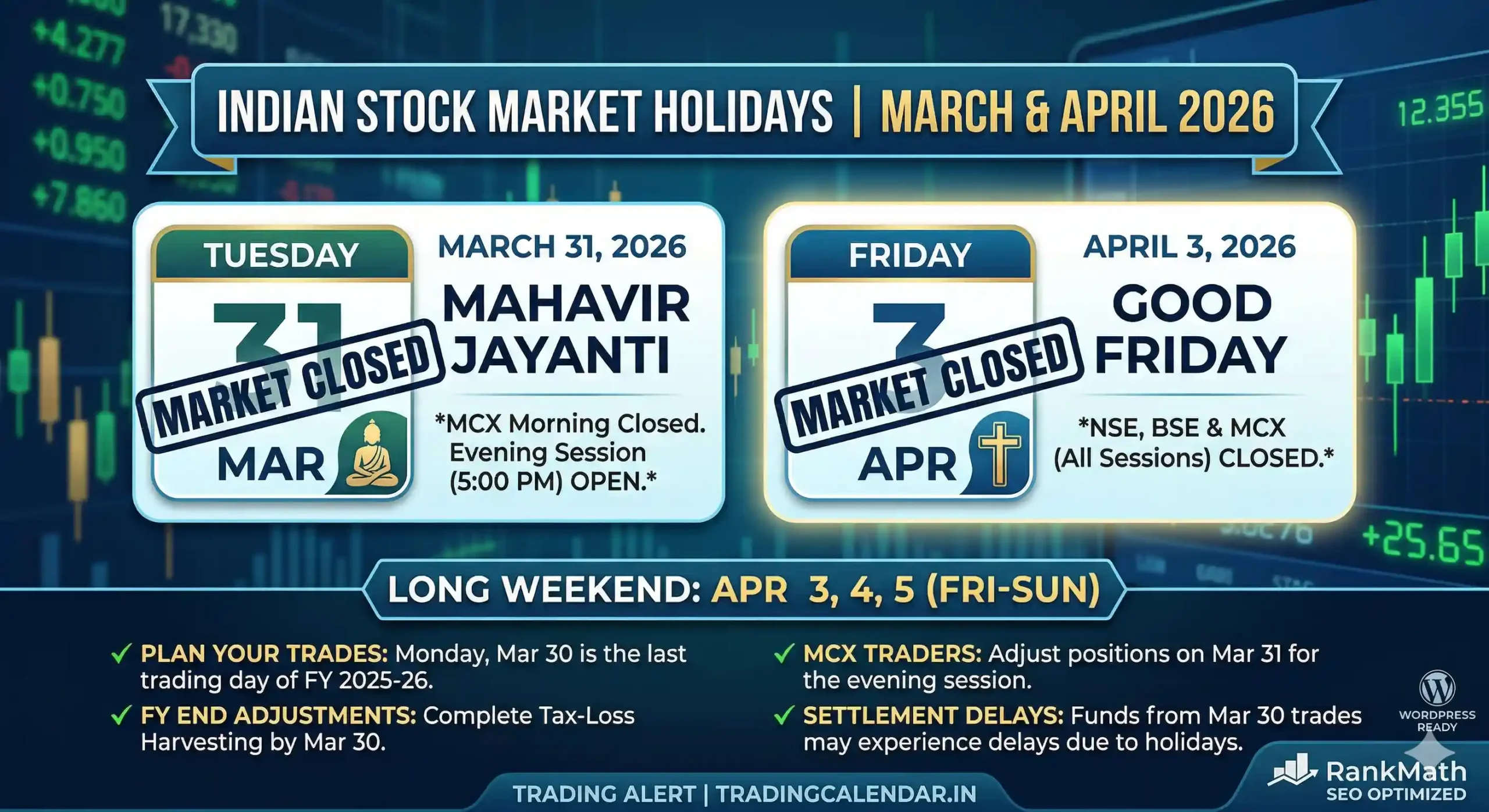
- Market Closure: Both the NSE and BSE will remain closed on Tuesday, March 31, 2026, for Mahavir Jayanti.
- Long Weekend: The markets will also be shut on Friday, April 3, 2026, for Good Friday, leading into a three-day weekend.
- Fiscal Year End: March 31 marks the end of the financial year; however, because of the holiday, the final trading day of FY 2025-26 will be Monday, March 30.
- Commodity Trading: On March 31, the morning session for commodities is closed, but the evening session (starting at 5:00 PM) will be operational.
Critical Dates & Holiday Schedule
| Event | Date | Day | Market Status |
| Mahavir Jayanti | March 31, 2026 | Tuesday | Closed |
| Annual Bank Closing | April 01, 2026 | Wednesday | Open (Settlement Holiday) |
| Good Friday | April 03, 2026 | Friday | Closed |
Deep Dive: Indian Stock Market Holiday Analysis 2026
The transition from March to April 2026 presents a unique challenge for the Indian financial landscape. With two major holidays falling within the same week as the fiscal year-end and the start of a new one, traders must navigate a truncated schedule.
Business Model & Market Mechanism
The Indian stock market operates on a T+1 settlement cycle. However, holidays complicate this rhythm. When the market is closed on a Tuesday (March 31), any trades executed on Monday (March 30) will not be settled until the following working day. Furthermore, April 1 is the “Annual Bank Closing” day. While the stock exchanges remain open for trading on April 1, it is a Settlement Holiday. This means that while you can buy and sell stocks, the actual movement of funds and shares (payouts/pay-ins) will be pushed further down the line.
Financial Impact and Year-End Volatility
The closure on March 31 is particularly critical because it is the official end of the financial year. Traditionally, the last few days of March witness high volumes as institutional investors engage in “window dressing”—adjusting portfolios to make their year-end balance sheets look more attractive. Since the market is closed on the 31st, this activity will likely be compressed into a frantic trading session on March 30.
Traders looking to lock in “Tax-Loss Harvesting” (selling losing positions to offset capital gains tax) must complete their trades by the 30th. If you miss this window, your trades will count toward the new financial year (2026-27), potentially altering your tax liability.
SWOT Analysis of the March-April Holiday Window
Strengths:
- Systemic Cool-off: The mid-week break on March 31 allows the clearing corporations to manage the heavy year-end loads without the pressure of live trading.
- Reduced Speculation: Long weekends, like the one starting April 3, often discourage excessive intraday speculation, promoting more stable delivery-based investing.
Weaknesses:
- Liquidity Crunch: With multiple holidays, liquidity in the F&O (Futures and Options) segment can dry up, leading to wider bid-ask spreads.
- Margin Risks: Traders holding overnight positions over the long weekend (April 3-5) face the risk of major global news events impacting the market when it reopens.
Opportunities:
- Strategic Rebalancing: The downtime gives retail investors a chance to audit their portfolios away from the “noise” of the live ticker.
- Dividend Plays: Many companies announce year-end dividends; the holiday gap allows investors to research ex-dividend dates for the new fiscal year.
Threats:
- Global Decoupling: If the US Federal Reserve or European Central Bank makes a major announcement on Good Friday (while India is shut), the NSE/BSE could witness a massive gap-up or gap-down opening on Monday morning.
- Settlement Delays: The combination of a market holiday and a bank holiday (April 1) can lead to temporary liquidity shortages for traders relying on immediate fund payouts.
Peer Comparison: NSE/BSE vs. Global Exchanges
In 2026, India continues to have one of the highest numbers of market holidays compared to Western counterparts like the NYSE or the London Stock Exchange. While global markets are almost universally closed for Good Friday (April 3), the Mahavir Jayanti closure (March 31) is specific to India. This means that on March 31, Indian traders will be unable to react to movements in the S&P 500 or Nasdaq in real-time, creating a “latent” volatility that explodes at the opening bell on April 1.
Valuation and Market Sentiment
As we enter April 2026, market valuations are often scrutinized against the backdrop of the newly released Q4 earnings. The holiday period serves as a psychological “reset” button. Sentiment often turns bullish at the start of a new financial year as fresh capital allocations from Mutual Funds and FIIs (Foreign Institutional Investors) hit the market.
FAQ Section
Q: Can I place GTT orders on March 31, 2026? A: Yes, you can place Good-Till-Triggered (GTT) orders with your broker, but they will only be processed when the market opens on the next trading day, April 1.
Q: Is the MCX open on Good Friday? A: No. Unlike Mahavir Jayanti where the evening session is open, the MCX is completely closed for both morning and evening sessions on Good Friday, April 3.
Q: How does the bank holiday on April 1 affect my stock trading? A: You can still trade on April 1. However, since it is a bank holiday, your broker will not receive funds from the bank, and payouts will be delayed. It is essentially a “trading only, no settlement” day.
Q: Will there be an IPO listing on these holiday dates? A: No, IPO listings and allotments do not take place on exchange holidays. If an IPO was slated to list around this time, the dates would be shifted to the nearest working day.
Stock Market Holidays 2026| NSE Holiday List| BSE Holidays| Mahavir Jayanti 2026| Good Friday 2026| Trading Calendar India| Share Market News| NSE Closed Dates| Indian Stock Market.
Also View:
- 45 Weeks. 45 Lessons. From Basics to Advanced – Master Stock Market Investing in Less than 1 Year.
- Lesson 1: What is a Stock Market? Beginner’s Guide to Understanding Shares & Trading
- Cash Flow Statement: Why Profits Lie but Cash Never Does
📢 Join Our Market Community
📱 Stay updated on IPOs, Results & Market News:
- WhatsApp Channel: Join Now
- Telegram: Follow Updates
- Arattai: Connect with Us
📌 Stock Market Disclaimer
- Disclaimer: This post is for informational and educational purposes only and does not constitute financial advice or a recommendation to buy/sell any stock or share. Investing in the stock market involves risk. Past performance is not indicative of future results. Always conduct your own research or consult a licensed financial advisor before making investment decisions.
- The information provided on this platform is for educational and informational purposes only. It should not be considered as investment advice, stock recommendations, or financial guidance.
- ⚠️ Stock Market Investments
- Investing in equities, derivatives, mutual funds, and other financial instruments involves market risks, volatility, and the possibility of capital loss.
- Past performance of stocks or indices is not indicative of future returns.
- Always conduct your own research or consult a SEBI-registered financial advisor before making investment decisions.
- ⚠️ IPO (Initial Public Offerings)
- IPO details, issue size, subscription data, and allotment status shared here are based on publicly available information from company filings, stock exchanges, and merchant bankers.
- Investing in IPOs carries risks including listing volatility, business uncertainties, and sector performance dependency.
- Neither acceptance of applications nor allotment guarantees profits. Investors should evaluate their risk appetite before subscribing.
- ⚠️ GMP (Grey Market Premium)
- Grey Market Premium (GMP) is an unofficial and unregulated indicator of expected IPO listing price.
- GMP data is collected from market observers and informal trading circles; it does not have any legal or SEBI recognition.
- GMP values are highly speculative and may differ significantly from actual listing prices. Investors should not rely solely on GMP while taking investment decisions.
- ✅ General Advisory
- We do not provide any buy/sell/hold recommendations.
- Readers and investors are solely responsible for their investment actions and decisions.
- This platform, its authors, and affiliates are not liable for any direct or indirect financial loss arising from the use of this information.
- 🔒 Always invest responsibly and diversify your portfolio.