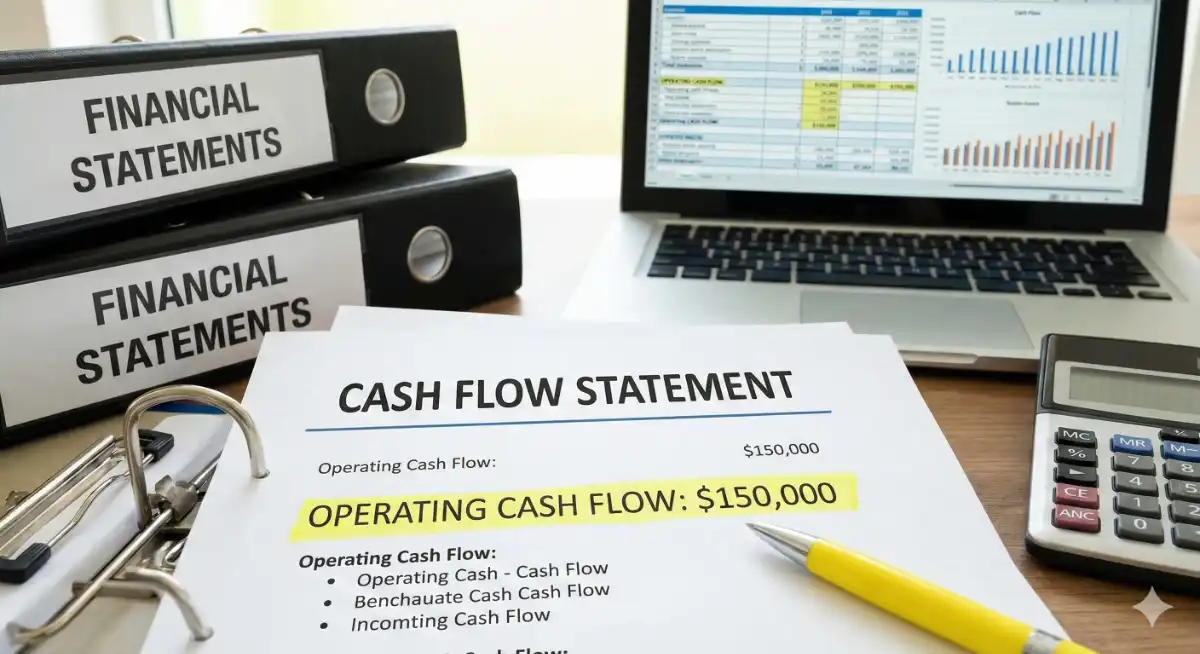
Cash Flow Statement| Cash Flow Statement| Financial Statements| Operating Cash Flow| Investing Cash Flow| Financing Cash Flow| Stock Market Education| Fundamental Analysis
Lesson 18: Cash Flow Statements
Learning Outcome: Understand Operating, Investing, and Financing cash flows
Key Takeaway: Cash is king, not just profits
🌱 Introduction: The Reality Behind the Numbers
Many companies proudly announce record profits. Headlines celebrate growth. Analysts applaud earnings. Yet, silently, some of these very companies struggle to pay salaries, delay vendor payments, or raise debt just to survive. This contradiction exists because profit is an opinion, but cash is a fact.
The Cash Flow Statements is the most honest financial statement. While the Profit & Loss Statement shows performance and the Balance Sheet shows position, the Cash Flow Statements shows movement — real money entering and leaving the business. It answers one brutal question: Is this business actually generating cash, or just accounting profits?
In the Indian stock market, countless retail investors have been trapped by companies showing rising profits but collapsing later due to cash shortages. The reason is simple — profits can be adjusted through accounting policies, depreciation methods, or revenue recognition. Cash cannot be manipulated easily.
A company can survive years without profits, but it cannot survive without cash. Salaries, rent, interest, taxes — everything demands cash. This is why seasoned investors always say:
“Cash is king, not just profits.”
This lesson will reshape how financial statements are read. You will learn how operating cash flows reveal business strength, how investing cash flows expose expansion or distress, and how financing cash flows tell stories of dependence or confidence. By the end, the Cash Flow Statements will no longer be a boring table — it will become a truth detector.
📄 What Is a Cash Flow Statements?
A Cash Flow Statements records actual inflow and outflow of cash and cash equivalents during a specific period. It does not care about credit sales, future income, or accounting assumptions. It tracks real money.
Why it exists:
- Profit includes non-cash items (depreciation, provisions)
- Revenue may be booked without receiving cash
- Expenses may be recorded without paying cash immediately
The Cash Flow Statements corrects this illusion by answering:
- How much cash did the business generate from operations?
- Where did the business invest cash?
- How did the business raise or repay money?
🔁 Structure of Cash Flow Statements
The statement is divided into three sections:
- Operating Activities
- Investing Activities
- Financing Activities
Each section tells a different story — and together, they reveal the company’s real financial health.
🟢 Operating Cash Flows (OCF): The Heartbeat of Business
Operating Cash Flows represents cash generated from core business operations. This is the most important section because it shows whether the company’s main business model actually works in cash terms.
If operating cash flow is strong and consistent, the business can:
- Pay salaries and suppliers
- Service debt
- Fund expansion internally
If operating cash flow is weak or negative for long periods, the business is dependent on borrowing or equity dilution, no matter how profitable it looks on paper.
What it includes:
- Cash received from customers
- Cash paid to suppliers and employees
- Taxes paid
- Interest paid (as per Indian accounting treatment)
Example (Indian Market)
Consider Infosys.
Even during periods of moderate profit growth, Infosys consistently reports strong operating cash flows, often exceeding net profit. This signals:
- High-quality earnings
- Low working capital stress
- Real cash conversion
This is why long-term investors trust such businesses.
🔴 Red Flag: Profit Up, Operating Cash Down
A dangerous signal appears when:
- Net profit is rising
- Operating cash flow is falling or negative
This often indicates:
- Aggressive revenue recognition
- Rising receivables (customers not paying)
- Unsold inventory piling up
Many past market failures showed this pattern long before prices crashed.
🔵 Investing Cash Flows: Growth or Distress?
Investing cash flow shows where the company is putting its money for the future. This includes buying assets, investing in subsidiaries, or selling long-term investments.
Negative investing cash flow is not bad by default. In fact, growing companies often show negative investing cash flow due to capital expenditure.
The key is to ask:
👉 Is the company investing because it is growing — or selling assets because it is struggling?
What it includes:
- Purchase of plant & machinery
- Acquisition of businesses
- Sale of assets
- Investment in mutual funds, bonds, or subsidiaries
Example
Reliance Industries frequently reports large negative investing cash flow during expansion phases. This reflects long-term vision, not weakness. Markets often reward such investments when operating cash flow supports them.
🟣 Financing Cash Flows: Dependency Test
Financings cash flow shows how the company raises or repays capital. It reveals dependence on lenders or confidence to return money to shareholders.
A healthy mature company often:
- Repays debt
- Pays dividends
- Buys back shares
A weak company often:
- Borrows repeatedly
- Issues new shares frequently
What it includes:
- Loan taken or repaid
- Equity issued
- Dividends paid
Example
New-age companies like Zomato historically relied on financing cash inflows to fund operations. This is acceptable in early stages — but investors must watch whether operating cash flow eventually turns positive.
🔄 Direct vs Indirect Method (Clear Difference)
Indirect Method (Most Common in India)
- Starts with net profit
- Adjusts non-cash items
- Adjusts working capital changes
Direct Method
- Shows actual cash received and paid
- Rarely used due to complexity
For investors, indirect method is sufficient if interpreted correctly.
💥 Cash Flow vs Profit: The Ultimate Truth
| Aspect | Profit | Cash |
|---|---|---|
| Can be manipulated | Yes | No |
| Includes non-cash items | Yes | No |
| Pays expenses | No | Yes |
| Keeps company alive | No | Yes |
This is why:
Cash is king, not just Profits
🧠 How Investors Should Read Cash Flows Statements
- Compare Operating Cash Flow vs Net Profit
- Track OCF consistency over years
- Study capex quality in investing section
- Watch debt dependency in financing section
- Combine with Balance Sheet & P&L
🚨 Common Red Flags
- Rising profits but negative OCF
- Asset sales funding operations
- Constant borrowing to pay expenses
- Dividend paid through debt
These are early warning signs most retail investors ignore.
✅ Conclusion: Cash Never Lies
The Cash Flows Statement is not optional reading — it is mandatory for serious investors. Companies may show profits, growth stories, and glossy presentations, but only cash flow reveals sustainability.
Those who master cash flow analysis avoid traps, survive market cycles, and build long-term wealth.
Remember this forever:
Cash is king, not just Profits.
❓ FAQs
1. Why is Cash Flows Statements important?
Because it shows real money movement, not accounting profits.
2. Can a profitable company fail?
Yes, if it runs out of cash.
3. Which cash flow is most important?
Operating cash flow.
4. Is negative investing cash flow bad?
Not always — it may indicate growth.
5. What is a dangerous sign in cash flow?
Profit up but operating cash flow down.
6. Do all companies follow the same format?
Yes, broadly under accounting standards.
7. Should beginners focus on cash flow?
Absolutely — it prevents major mistakes.
8. Is cash flow better than profit?
For survival and truth — yes.
Cash Flow Statements| Cash Flow Statement| Financial Statements| Operating Cash Flow| Investing Cash Flow| Financing Cash Flow| Stock Market Education| Fundamental Analysis
🔜 Next Lesson Preview
Lesson 19: Key Ratios
Learning Outcomes: PE, PB, ROE, D/E ratios.
Key Takeaway: Ratios help in stock comparison
📌 Final Affiliate CTA
Start trading with professional order types, GTT automation and Mini brokerage
👉Open Your mStock Demat Account: Click Here
Also Visit:
- 45 Weeks. 45 Lessons. From Basics to Advanced – Master Stock Market Investing in Less than 1 Year.
- Lesson 1: What is a Stock Market? Beginner’s Guide to Understanding Shares & Trading
- Lesson 13: Intraday vs Delivery. What trade to do!
- Lesson 14: Short Selling & Margin Trading
- Lesson 15: Settlement System: How Your Trade Becomes Real Money and Shares
- Lesson 16: Introduction: Understanding the Balance Sheet Analysis!
Course Introduction:
Open Demat Account
by Mirae Asset (m,Stock)


-
Top 10 Stocks to Watch: Q1 Earnings Momentum & Sectoral Breakouts (August 3, 2026): Weekly Market Intelligence: 10 Stocks to Watch
Dalal Street is stepping into August 2026 with a strong stock-specific bias driven by the Q1 FY27 earnings season. While elevated crude oil prices and global rate decisions keep broad-index rallies in check, institutional capital is actively rotating into power grid equipment, non-ferrous metals, automotive outperformance, and high-margin private banks. Technically, the Nifty 50 faces…
-
Trading Alert: Indian Stock Market Holidays on March 31 and Good Friday 2026
Stock Market Holidays 2026| NSE Holiday List| BSE Holidays| Mahavir Jayanti 2026| Good Friday 2026| Trading Calendar India| Share Market News| NSE Closed Dates| Indian Stock Market. Critical Dates & Holiday Schedule Event Date Day Market Status Mahavir Jayanti March 31, 2026 Tuesday Closed Annual Bank Closing April 01, 2026 Wednesday Open (Settlement Holiday) Good…
-
Nifty 50 and Sensex Post-Bloodbath Analysis: Recovery or Trap?
Nifty 50 Prediction Tomorrow| Sensex Analysis March 2026| Indian Stock Market Recovery| Stock Market Bloodbath Reasons The Indian stock market recently faced a “Black Monday” on March 23, 2026, where the Sensex plunged nearly 2,000 points and the Nifty 50 tumbled over 600 points. However, the session on Tuesday, March 24, has brought a sigh…