Iran-Israel War Market Impact| Operation Lion’s Roar update| Effect of Iran war on Nifty 50| Crude oil price surge 2026| Israel Iran conflict live status
Introduction: “Operation Lion’s Roar” Unleashes Geopolitical Turmoil
The Middle East, a perennial tinderbox, has ignited with an intensity unseen in decades. What was a simmering geopolitical rivalry between Iran and Israel, further complicated by US involvement, exploded into open warfare on the morning of Saturday, February 28, 2026. Codenamed “Operation Lion’s Roar,” a joint Israeli-US military offensive has commenced, targeting strategic sites across Iran. This swift and decisive action, coupled with Iran’s immediate and forceful retaliation, has sent shockwaves across the globe, fundamentally altering the geopolitical landscape and, critically, setting the stage for extreme volatility in financial markets worldwide, especially when the Indian markets open this Monday.
For investors, particularly those in India, understanding the immediate and projected long-term consequences of this conflict is paramount. From the dramatic surge in crude oil prices to the flight to safe-haven assets like gold, and the anticipated downturn in equity markets, the ripple effects will be profound and far-reaching. This deep dive will dissect the current status of the war, the events leading up to it, and provide a detailed analysis of its likely impact on the Indian market, offering insights for navigating the stormy waters ahead.
1. The Roar of Conflict: Current Status of the Iran-Israel War (February 28, 2026)
The dawn of February 28, 2026, marked a stark departure from the tense diplomatic standoffs of recent weeks. The situation has unequivocally escalated into a state of active, full-scale warfare.
- Joint Offensive: “Operation Lion’s Roar” Commences: In a coordinated and overwhelming display of military might, Israel and the United States launched “Operation Lion’s Roar.” This multi-pronged offensive utilized a combination of advanced missile systems and aerial bombardment, striking deep into Iranian territory.
- Key Iranian Targets Hit: Initial reports confirm that major cities across Iran, including the capital Tehran, Qom, Isfahan, and Karaj, have been subjected to intense bombardment. Of particular note are the confirmed strikes on the district in Tehran believed to house the residence of Supreme Leader Ayatollah Ali Khamenei, as well as the Presidential Palace and the National Security Council. These high-profile targets underscore the strategic objective of the operation.
- US Declares “Major Combat Operations” and Calls for Regime Change: US President Donald Trump, in a televised address, confirmed that the United States had initiated “major combat operations.” He explicitly stated the primary objectives were to “destroy Iran’s missile capabilities” and “prevent it from obtaining nuclear weapons.” In a highly provocative move, President Trump also openly called for regime change in Iran, directly urging the Iranian populace to rise and take control of their government. This declaration dramatically raises the stakes, moving beyond containment to a direct challenge to the Islamic Republic’s existence.
- Iran’s “Crushing Response”: True to its word, Tehran has launched what it terms a “crushing response.” Iranian missile forces have retaliated by firing volleys of missiles towards northern Israel. Concurrently, US military bases stationed in the Persian Gulf region have also come under attack. Reports from Bahrain, the UAE, and Qatar confirm explosions or successful interceptions of Iranian missiles within their airspace. Tragically, one fatality has been confirmed in Abu Dhabi, attributed to falling shrapnel, highlighting the immediate human cost of this escalation.
- Airspace Lockdowns and Travel Chaos: The immediate consequence of active hostilities has been the widespread closure of airspace. Civilian flights over Iran, Iraq, Jordan, the UAE, and Qatar have been largely grounded or diverted, leading to massive flight cancellations and significant disruption to global travel and logistics.
2. The Eve of War: The Day Before (February 27, 2026)
The day preceding “Operation Lion’s Roar” was characterized by a palpable sense of dread and the final, unheeded warnings before the storm broke.
- IAEA Report Fuels Suspicions: A confidential report from the International Atomic Energy Agency (IAEA) proved to be a critical turning point. The report stated that the agency could no longer reliably verify Iran’s enriched uranium stockpile. Crucially, it noted “regular vehicular activity” at the highly sensitive Esfahan nuclear site, raising significant red flags about potential undeclared nuclear activities. This report likely served as the final trigger for the US and Israel.
- Trump’s Ominous Warning: President Trump, speaking to the press, had expressed his profound dissatisfaction with the pace and outcomes of ongoing negotiations. He reiterated that “all options remain on the table,” a thinly veiled threat that military force was a very real consideration. His tone indicated a clear loss of patience with the diplomatic process.
- US Authorizes Evacuations from Israel: In a stark indicator of imminent danger, the US Department of State authorized the immediate departure of non-essential government personnel and their families from Israel. Such a move is always a precursor to a significant security event.
- UK Withdraws Embassy Staff from Tehran: Mirroring the US actions, the United Kingdom temporarily withdrew its embassy staff from Tehran, citing the rapidly deteriorating security situation. This diplomatic exodus underscored the international community’s recognition of an impending crisis.
3. The Failure of Diplomacy: Previous Days’ Talks
The desperate attempts to de-escalate the crisis through diplomacy ultimately failed, paving the way for military action. Negotiations, mediated by Omani Foreign Minister Badr al-Busaidi, had been ongoing in Geneva but reached an irresolvable stalemate earlier in the week.
- US Demands for “Zero-Enrichment”: The core of the US negotiating position, led by Special Envoys Jared Kushner and Steve Witkoff, centered on a demand for Iran to completely dismantle its Fordow and Natanz nuclear enrichment facilities. Furthermore, the US insisted that Iran ship its entire stockpile of enriched uranium to the United States. This was a non-negotiable “zero-enrichment” policy.
- Iran’s Unwavering Stance: Tehran vehemently refused to comply with the demands to dismantle its nuclear facilities or to export its enriched uranium. Its counter-demand was for the immediate and full lifting of all international sanctions, viewing this as a prerequisite for any further concessions.
- “Breakthrough” Claims vs. Skepticism: While Oman’s Foreign Minister initially claimed a “breakthrough,” suggesting Iran had agreed to cease further stockpiling of enriched uranium, US officials remained deeply skeptical. The perceived lack of genuine commitment from Iran, coupled with the concerning IAEA report, led to the US and Israel concluding that a pre-emptive military strike was the only viable option to prevent Iran from developing nuclear weapons.
4. Crafting the Narrative: According to the WordPress Post’s SEO Strategy
For a WordPress post aiming to capture the market’s attention amidst such a crisis, the content must be strategically structured and visually compelling. The “Iran-Israel War Market Impact” focus keyword demands a comprehensive yet accessible analysis.
- Framing the Event: “Systemic Shock”: The immediate framing of this conflict is crucial. It is not merely a regional skirmish but a “Systemic Shock” – an event capable of disrupting fundamental global systems, especially energy and finance. This terminology should be integrated throughout the content.
- SEO Pillars: “Geopolitical Risk” and “Energy Security”: Beyond the primary focus keyword, secondary SEO terms like “Geopolitical Risk,” “Energy Security,” “Crude Oil Price Surge,” “Gold Safe Haven,” and “Indian Market Volatility” should be naturally woven into the narrative.
- Critical Data Point: The “Conflict Timeline”: In this context, the most critical data points aren’t traditional IPOs but the direct chronological impact on markets. A clear “Conflict Timeline” table would be invaluable:
- February 28, 2026 (Saturday): “Operation Lion’s Roar” Launched; Iran Retaliates. Global markets closed.
- February 29, 2026 (Sunday): Intense Diplomatic Activity; Further Military Actions Possible.
- March 2, 2026 (Monday): Global Markets Reopen; Indian Market Braces for Impact.
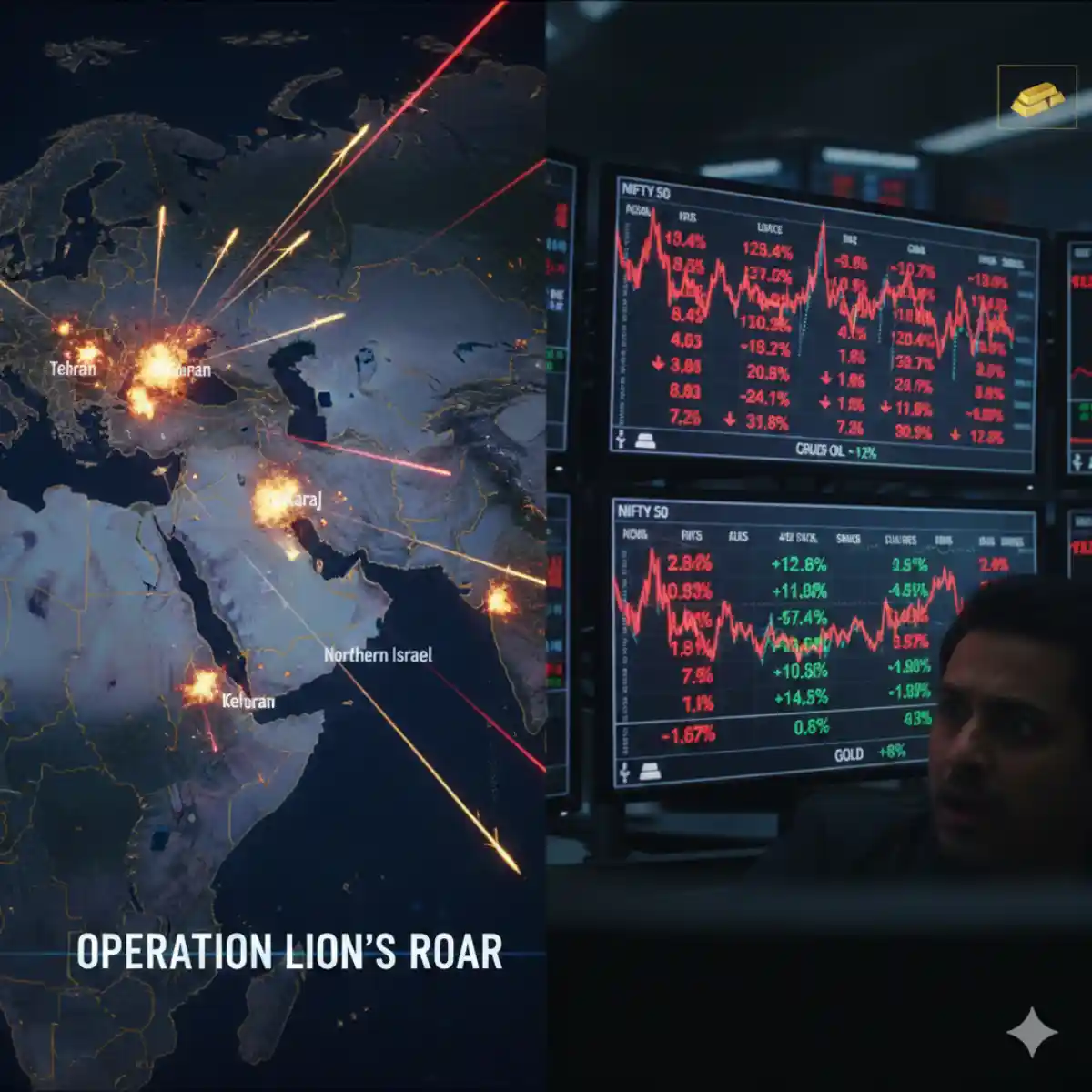
- Visual Reinforcement: The Canva Prompt: To enhance engagement, a powerful visual is essential. The following Canva prompt encapsulates the duality of the crisis: “A dramatic, high-quality cinematic digital art piece showing a split screen: one side a dark, glowing map of the Middle East with missile trajectories and exploding conflict zones, the other side a highly dynamic stock market ticker screen flashing predominantly red, with a subtle undertone of gold price surge, all set in a dimly lit, high-tension trading room environment. The overall mood should be urgent and foreboding.”
5. The Fallout: Effect on the Indian Market on Monday (March 2, 2026)
The Indian markets, like their global counterparts, are poised for an extremely volatile and challenging opening when they resume trading on Monday, March 2, 2026. The weekend’s developments ensure a turbulent start to the trading week.
- Anticipated Gap-Down Opening for Equities:
- Nifty 50 and Sensex: Analysts widely expect a significant gap-down opening for both the Nifty 50 and the Sensex. The intensity of the conflict and the immediate impact on global risk sentiment will likely trigger heavy selling pressure from institutional investors.
- “Partially Priced In” Argument: Some market strategists argue that a portion of the “worst-case scenario” might already be “partially priced in.” This stems from the fact that the Indian market experienced a sharp sell-off in the latter half of Friday’s trading session as news of escalating tensions began to filter through. However, the scale of current hostilities far exceeds those pre-market jitters.
- Key Support Levels to Watch: Traders will be closely monitoring critical support levels for the Nifty 50, with breaks below these points potentially accelerating panic selling. Expect strong downside momentum in the initial hours.
- Crude Oil: The Single Biggest Headwind:
- Price Surge: The most immediate and severe impact will be felt in the crude oil market. With the Middle East now an active war zone and vital shipping lanes through the Persian Gulf at risk, Brent crude prices are projected to surge dramatically. The market will react to both actual supply disruptions and, crucially, the fear premium.
- Critical Threshold: $80-$85/barrel: If Brent crude crosses and sustains above the $80-$85 per barrel range, it will exert immense pressure on the Indian economy.
- Inflationary Pressures: Higher crude oil prices directly translate to increased import bills, leading to higher domestic fuel prices and broad-based inflation. This could force the Reserve Bank of India (RBI) to maintain a hawkish stance for longer, impacting growth.
- Rupee Depreciation: The Indian Rupee (INR) is highly sensitive to crude oil prices. A sharp rise in oil costs will likely lead to significant depreciation of the INR against the US Dollar, making imports more expensive and potentially triggering capital outflows. This could easily see the Rupee test new lows.
- Impact on Oil Marketing Companies (OMCs): Indian OMCs (e.g., IOC, BPCL, HPCL) will face severe margin pressure if they are unable to fully pass on the increased crude costs to consumers due to government intervention or competitive pressures.
- Gold and Silver: The Ultimate Safe Havens:
- Gap-Up Opening Expected: As geopolitical uncertainty spirals, investors will flock to traditional safe-haven assets. Gold and Silver are anticipated to see a significant gap-up opening on Monday.
- New All-Time Highs for Domestic Gold: Domestic gold prices, denominated in INR, could easily test and surpass new all-time highs. The dual effect of rising international gold prices (due to global risk aversion) and a depreciating Rupee will amplify gains for Indian gold investors.
- Investor Sentiment: This surge underscores a fundamental shift in investor sentiment from risk-on to extreme risk-off.
- Volatility Factor: Nifty Weekly Expiry and Holi Holiday:
- Amplified Swings: The fact that Monday, March 2, 2026, coincides with the Nifty weekly expiry (shifted due to the Holi holiday on Tuesday, March 3rd) will significantly amplify market volatility. Options writers will face massive unwinding pressures, potentially leading to sharp price swings and forced liquidations. This adds another layer of complexity and risk for traders.
- Reduced Trading Week: The shorter trading week due to Holi will mean fewer opportunities for markets to absorb and process news, potentially making each trading day more volatile.
Navigating the Storm: Strategies for Indian Investors
In times of such extreme uncertainty, a measured and strategic approach is crucial:
- Review Portfolio Allocation: Re-evaluate your asset allocation. Consider whether your portfolio has adequate exposure to defensive assets like gold, sovereign bonds, or even cash.
- Avoid Panic Selling: While instinct might dictate selling everything, indiscriminate panic selling can lock in losses. Focus on fundamentally strong companies that can weather economic downturns.
- Monitor Crude Oil and INR: Keep a very close eye on crude oil prices and the INR/USD exchange rate. These will be leading indicators for broader market and economic health.
- Quality over Quantity: In equities, prioritize high-quality, cash-rich companies with strong balance sheets and consistent earnings. Avoid highly leveraged companies or those sensitive to discretionary spending.
- Consider Hedging: For sophisticated investors, options strategies can be used to hedge against downside risk in equity portfolios.
- Long-Term Perspective: Remember that geopolitical events, while impactful in the short term, often resolve over time. Maintain a long-term perspective and avoid making impulsive decisions based on daily market movements.
Conclusion: A New Era of Geopolitical Uncertainty
“Operation Lion’s Roar” represents a seismic shift in global geopolitics, ushering in an era of heightened uncertainty and risk. The immediate fallout will be most acutely felt in energy markets, sending crude oil prices soaring and putting immense pressure on import-dependent economies like India. While gold will shine as a safe haven, equity markets are bracing for a tumultuous ride.
For Indian investors, Monday, March 2, 2026, will be a critical day. Understanding the forces at play – from the direct military actions to the intricate web of economic consequences – is essential. By remaining informed, exercising caution, and adopting a disciplined investment approach, one can hope to navigate these unprecedented times. The road ahead will be challenging, but clear-headed decision-making will be the most valuable asset in every investor’s portfolio.
Iran-Israel War Market Impact| Operation Lion’s Roar update| Effect of Iran war on Nifty 50| Crude oil price surge 2026| Israel Iran conflict live status
Also View:
- 45 Weeks. 45 Lessons. From Basics to Advanced – Master Stock Market Investing in Less than 1 Year.
- Lesson 1: What is a Stock Market? Beginner’s Guide to Understanding Shares & Trading
- Cash Flow Statement: Why Profits Lie but Cash Never Does
📢 Join Our Market Community
📱 Stay updated on IPOs, Results & Market News:
- WhatsApp Channel: Join Now
- Telegram: Follow Updates
- Arattai: Connect with Us
📌 Stock Market Disclaimer
- Disclaimer: This post is for informational and educational purposes only and does not constitute financial advice or a recommendation to buy/sell any stock or share. Investing in the stock market involves risk. Past performance is not indicative of future results. Always conduct your own research or consult a licensed financial advisor before making investment decisions.
- The information provided on this platform is for educational and informational purposes only. It should not be considered as investment advice, stock recommendations, or financial guidance.
- ⚠️ Stock Market Investments
- Investing in equities, derivatives, mutual funds, and other financial instruments involves market risks, volatility, and the possibility of capital loss.
- Past performance of stocks or indices is not indicative of future returns.
- Always conduct your own research or consult a SEBI-registered financial advisor before making investment decisions.
- ⚠️ IPO (Initial Public Offerings)
- IPO details, issue size, subscription data, and allotment status shared here are based on publicly available information from company filings, stock exchanges, and merchant bankers.
- Investing in IPOs carries risks including listing volatility, business uncertainties, and sector performance dependency.
- Neither acceptance of applications nor allotment guarantees profits. Investors should evaluate their risk appetite before subscribing.
- ⚠️ GMP (Grey Market Premium)
- Grey Market Premium (GMP) is an unofficial and unregulated indicator of expected IPO listing price.
- GMP data is collected from market observers and informal trading circles; it does not have any legal or SEBI recognition.
- GMP values are highly speculative and may differ significantly from actual listing prices. Investors should not rely solely on GMP while taking investment decisions.
- ✅ General Advisory
- We do not provide any buy/sell/hold recommendations.
- Readers and investors are solely responsible for their investment actions and decisions.
- This platform, its authors, and affiliates are not liable for any direct or indirect financial loss arising from the use of this information.
- 🔒 Always invest responsibly and diversify your portfolio.