India EU FTA 2026| India EU Trade Deal| Tariff cuts India EU| CBAM India EU agreement| India EU Services Trade
Date: January 27, 2026| Location: New Delhi / Brussels
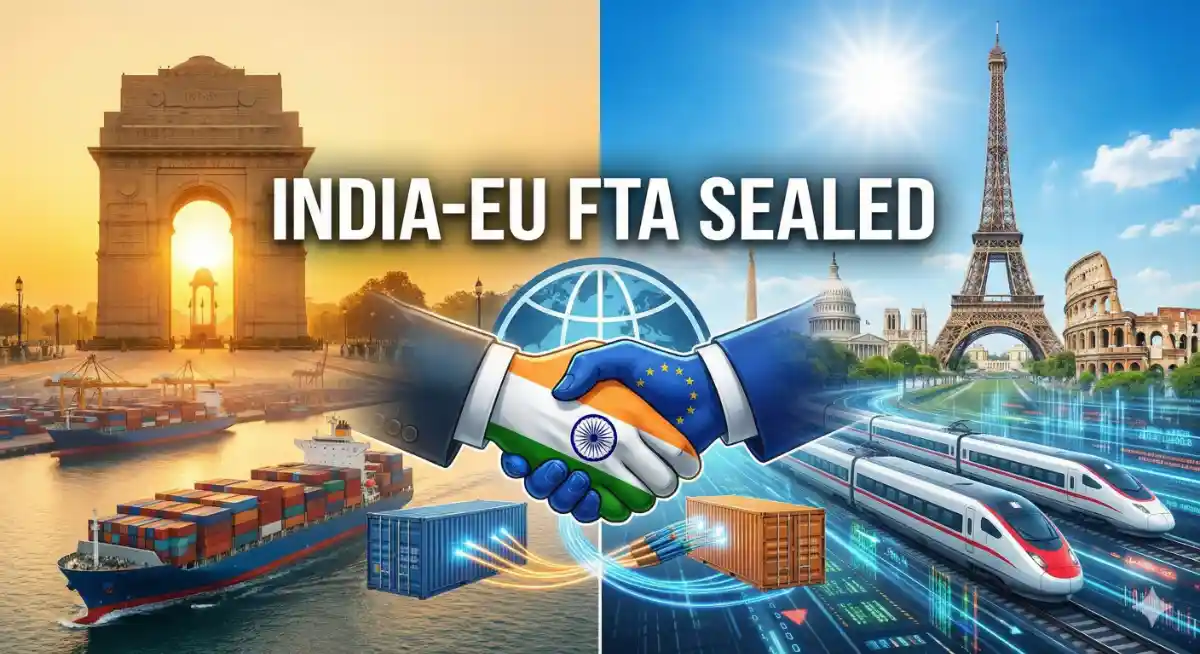
After 19 years of stop-start negotiations, India and the European Union have finally concluded the India-EU Free Trade Agreement (FTA). Announced jointly by Prime Minister Narendra Modi and European Commission President Ursula von der Leyen in New Delhi, this agreement is being hailed as the “Mother of All Deals,” linking two economies that together account for 25% of the global GDP.
This report provides a granular analysis of the deal, covering tariff rationalization, the breakthrough on carbon taxes (CBAM), services mobility, and the road to ratification.
Critical Deal Snapshot
| Component | Details |
| Status | Negotiations Concluded (Jan 27, 2026) |
| Market Access | EU drops tariffs on 99.5% of Indian exports. |
| Auto Tariffs | India reduces duties from 110% to 40% (immediate), eventually to 10%. |
| Wine/Spirits | India reduces duties from 150% to 30-40%. |
| Services | “Privileged Access” for Indian IT, nursing, and accounting professionals. |
| Key Exclusion | India’s Dairy and Sensitive Agriculture sectors protected. |
| Projected Trade | Bilateral trade expected to cross $250 Billion by 2035. |
| Implementation | Expected Late 2026 / Early 2027 (Post-Ratification). |
1. The Tariff Rationalization: Give and Take
The core of the deal involves massive tariff eliminations, opening up the €22.5 trillion European market to Indian exporters while allowing European luxury goods easier access to the growing Indian middle class.
A. For Indian Exporters (The Offensive Interests)
The EU has agreed to eliminate tariffs on 99.5% of tariff lines immediately upon implementation. This is a game-changer for India’s labor-intensive sectors that previously faced duties ranging from 6% to 14% under the EU’s GSP graduation mechanism.
- Textiles & Apparel: Immediate zero-duty access. This levels the playing field with Bangladesh and Vietnam, which have long enjoyed duty-free status.
- Leather & Footwear: High tariffs removed, expected to revitalize the clusters in Agra and Tamil Nadu.
- Gems & Jewellery: 4% duty eliminated, boosting competitiveness against other global hubs.
- Marine Products: Duties of up to 26% on Indian shrimp and frozen fish slashed to zero.
B. For European Exporters (The Defensive Interests)
India has offered tariff concessions on over 90% of tariff lines, but with crucial safeguards.
- Automobiles (The Big Breakthrough):
- Current State: 100-110% import duty.
- New Deal: Tariffs slashed to 40% immediately for a fixed quota of luxury European cars (Petrol/Diesel/EV).
- Future Outlook: Tariffs will progressively reduce to 10% over a 5-7 year horizon. Mass-market cars (under ₹25 Lakh) remain protected to shield domestic manufacturers like Tata and Maruti.
- Wines & Spirits:
- Current State: 150% duty.
- New Deal: Tariffs reduced to 30-40% progressively.
- Minimum Import Price (MIP): The cuts apply only to wines priced above a certain threshold (likely $5 per bottle equivalent), ensuring cheap European wines do not flood the Indian market.
2. Services and Mobility: The “Visa” Win
Unlike traditional trade deals focused on goods, India’s primary offensive interest was in Services (Mode 4)—the movement of natural persons.
- Privileged Access: The deal creates a “predictable pathway” for Indian professionals to work in the EU.
- Sectors Covered: IT and ITeS, Accounting, Nursing/Healthcare, and Engineering.
- Mutual Recognition Agreements (MRAs): The framework establishes a timeline to recognize professional degrees, meaning an Indian chartered accountant or nurse’s qualifications will be valid in EU member states without redundant certifications.
3. The Sticking Points: How They Were Resolved
Negotiations nearly stalled in late 2025 over “Sustainability” and “Carbon Taxes.” Here is how the deadlock was broken:
The CBAM (Carbon Border Adjustment Mechanism) Solution
The EU’s Carbon Tax on steel and aluminum was a major hurdle for India.
- The Compromise: India secured a Most Favored Nation (MFN) Assurance. This means if the EU grants any flexibility, waiver, or offset to another country (like the US or China) regarding CBAM, it automatically applies to India.
- Recognition of Domestic Carbon Credit: The EU has agreed to a technical working group that will examine recognizing India’s own Carbon Credit Trading Scheme (CCTS), potentially allowing Indian steelmakers to offset EU taxes with domestic certificates.
Geographical Indications (GIs)
- Protection: India agreed to protect valuable European GIs (e.g., Champagne, Feta Cheese, Parma Ham) from domestic imitation.
- Reciprocity: In return, Indian GIs (e.g., Basmati Rice, Darjeeling Tea, Alphonso Mango) receive strengthened legal protection across all 27 EU nations.
4. Strategic Exclusions: What India Protected
To ensure the deal is politically viable domestically, India maintained a “Negative List” of items where no tariff cuts were offered:
- Dairy: To protect the livelihood of millions of small cooperative farmers (Amul model). European cheese and milk powder will not get duty-free access.
- Sensitive Agriculture: Wheat, rice (non-Basmati), poultry, and certain fruits remain protected.
- MSME Procurement: Government procurement rules remain tilted to favor Indian MSMEs, resisting EU demands for full access to Indian government tenders.
5. Future Outlook and Timeline
The “Conclusion of Negotiations” is the political seal. The legal process follows:
- Phase 1: Legal Scrubbing (Feb – July 2026): Lawyers from both sides will verify the legal text (thousands of pages) to ensure no ambiguity.
- Phase 2: Translation: The deal must be translated into all 24 official EU languages.
- Phase 3: Signing (Early 2027): Formal signing ceremony.
- Phase 4: Ratification:
- India: Cabinet approval (fast).
- EU: Approval by the European Parliament. (Note: Since this is an “EU-only” competency deal, it may not require ratification by all 27 individual national parliaments, drastically speeding up the process).
- Entry into Force: Likely mid-to-late 2027.
FAQ: India-EU Trade Deal
Q1: Will European luxury cars become cheaper in India?
A: Yes. Once the deal is implemented (likely 2027), import duties on luxury cars (Mercedes, BMW, Audi) will drop from 110% to 40% immediately for a specific quota, and eventually to 10%, leading to significant price reductions.
Q2: Did India open up its dairy market to Europe?
A: No. The Dairy sector was a “Red Line” for India. Indian farmers are protected, and European dairy products will not receive duty-free access.
Q3: How does this help Indian job seekers?
A: The services agreement facilitates “mobility” for skilled professionals. It will be easier for Indian IT workers, nurses, and accountants to get work visas and have their degrees recognized in EU countries.
Q4: What is the impact on the “Make in India” initiative?
A: It is a boost. By removing duties on Indian industrial goods (textiles, leather, machinery), Indian factories become more competitive globally, encouraging companies to manufacture in India for export to Europe.
Q5: What is the “Mother of All Deals”?
A: This phrase was used by European officials to describe the scale of the agreement, as it covers trade, investment protection, and geographical indications between two of the world’s largest democracies.
India EU FTA 2026| India EU Trade Deal| Tariff cuts India EU| CBAM India EU agreement| India EU Services Trade
Also View:
📢 Join Our Market Community
📱 Stay updated on IPOs, Results & Market News:
- WhatsApp Channel: Join Now
- Telegram: Follow Updates
- Arattai: Connect with Us
📌 Stock Market Disclaimer
- Disclaimer: This post is for informational and educational purposes only and does not constitute financial advice or a recommendation to buy/sell any stock or share. Investing in the stock market involves risk. Past performance is not indicative of future results. Always conduct your own research or consult a licensed financial advisor before making investment decisions.
- The information provided on this platform is for educational and informational purposes only. It should not be considered as investment advice, stock recommendations, or financial guidance.
- ⚠️ Stock Market Investments
- Investing in equities, derivatives, mutual funds, and other financial instruments involves market risks, volatility, and the possibility of capital loss.
- Past performance of stocks or indices is not indicative of future returns.
- Always conduct your own research or consult a SEBI-registered financial advisor before making investment decisions.
- ⚠️ IPO (Initial Public Offerings)
- IPO details, issue size, subscription data, and allotment status shared here are based on publicly available information from company filings, stock exchanges, and merchant bankers.
- Investing in IPOs carries risks including listing volatility, business uncertainties, and sector performance dependency.
- Neither acceptance of applications nor allotment guarantees profits. Investors should evaluate their risk appetite before subscribing.
- ⚠️ GMP (Grey Market Premium)
- Grey Market Premium (GMP) is an unofficial and unregulated indicator of expected IPO listing price.
- GMP data is collected from market observers and informal trading circles; it does not have any legal or SEBI recognition.
- GMP values are highly speculative and may differ significantly from actual listing prices. Investors should not rely solely on GMP while taking investment decisions.
- ✅ General Advisory
- We do not provide any buy/sell/hold recommendations.
- Readers and investors are solely responsible for their investment actions and decisions.
- This platform, its authors, and affiliates are not liable for any direct or indirect financial loss arising from the use of this information.
- 🔒 Always invest responsibly and diversify your portfolio.
Open Demat Account
by Mirae Asset (m,Stock)

-
The Great Lockdown: Iran’s Strategic Halt of Food Exports in 2026
Iran Food Export Ban| Iran Agricultural Halt 2026| Middle East Food Security Crisis| Iran Domestic Supply Protection| Iran Food Export…
-
Iran-Israel War: Unpacking “Operation Lion’s Roar” and its Ripple Effect on Global Markets – A Deep Dive for Indian Investors
Iran-Israel War Market Impact| Operation Lion’s Roar update| Effect of Iran war on Nifty 50| Crude oil price surge 2026|…
-
The Tariff Tussle: Decoding the Legal Challenge to Executive Trade Power
Supreme Court| Tariffs| Trade War 2026| Donald Trump| IEEPA| Section 301| US Economy| Import Duties| Constitutional Law| Reciprocal Trade Act…
-
The 2025-26 Market Journey: From All-Time Highs to the “Retail Trap” Panic
Indian Stock Market Performance 2025-26| Nifty 50 Returns FY26| Why is Market Falling Feb 2026| Hold or Sell Indian Stocks|…
-
Indian Stock Market Update Feb 20: Nifty Reclaims 25,550, Sensex Jumps 316 Pts Amid Global Cues
Indian Stock Market Update Feb 20| Nifty 50 today| Sensex closing| Top gainers and losers Market Snapshot: The Bulls Fight…
-
Indian Stock Market Today: Bulls Charge Ahead as Sensex and Nifty Rally on Banking & IT Strength
# Indian Stock Market Today: Sensex and Nifty Close Higher Amid Broad-Based Buying ## Indian Stock Market Report – Updated…