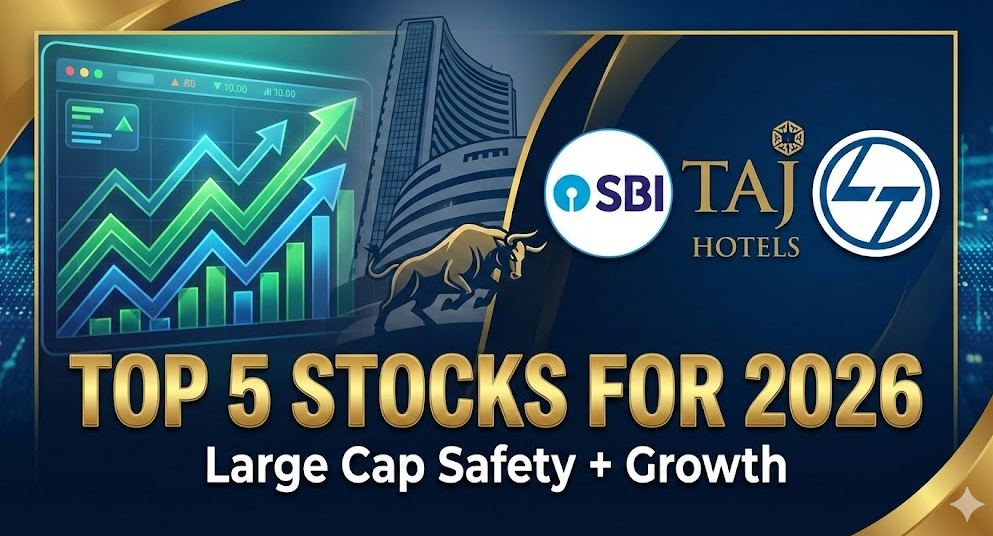
Best Long-Term Stocks 2026| Fundamental Analysis Indian Stocks| Portfolio for 2026| Large Cap Stocks with Mid Cap Growth| 5 Quality Stock
As we approach the new calendar year, smart investors are looking beyond short-term volatility. The goal for 2026 is clear: find the “sweet spot” in the market—companies that offer the safety of large-cap giants but the growth potential typically associated with mid-caps.
Based on extensive market analysis, we have identified five fundamentally strong companies that fit this criteria perfectly. These are not just stocks; they are nation-builders and market leaders with significant competitive advantages (moats).
Below is a deep dive into these 5 powerhouses for your long-term portfolio.
1. Indian Hotels Company Ltd (IHCL)
The Hospitality Leader
Indian Hotels is not just about the iconic Taj brand; it is a play on India’s rising consumption and tourism story. The company has successfully pivoted to a more profitable business model.
| Metric | Data |
| Current Price | ₹740 – ₹750 |
| Market Cap | ~₹1.5 Lakh Crore |
| P/E Ratio | ~62x (Historical Avg: 65x) |
| Book Value | ₹81 |
The Investment Thesis
The stock is trading at a reasonable valuation compared to its historical averages. With a P/E of 62 (vs. historical highs of 90-100), it offers a good entry point. The company recently recorded its highest-ever revenue in December 2024, signaling strong momentum.
Deep Dive: Business Moat & Strategy
- Ahvaan 2025 Strategy: IHCL is aggressively executing its “Ahvaan 2025” roadmap, focusing on margin expansion and portfolio growth.
- Asset-Light Model: Unlike the past, IHCL is expanding through management contracts rather than just owning properties. This reduces capital expenditure (capex) and improves Return on Capital Employed (ROCE).
- Diversified Revenue: Beyond rooms, IHCL is monetizing its F&B brands (TajSATS, Qmin) and entering the homestay market (Ama Stays), creating multiple revenue streams that are less cyclical.
Risk Factor: The hospitality industry is sensitive to global economic slowdowns and geopolitical events which can temporarily dampen travel demand.
2. State Bank of India (SBI)
The Proxy for India’s Economy
SBI is the giant of the Indian banking sector. With the cleanest balance sheet in years, it is poised for a significant re-rating.
| Metric | Data |
| Current Price | ₹969 |
| Target View | ₹1100+ |
| P/E Ratio | ~11x (Very Attractive) |
| Book Value | ₹617 |
The Investment Thesis
SBI is available at a “throwaway” valuation of ~11x P/E. The analyst predicts the stock will soon cross the psychological barrier of ₹1000 and head towards ₹1100. With a TTM (Trailing Twelve Months) profit of over ₹83,000 Cr, the bank is a cash-generating machine.
Deep Dive: Business Moat & Strategy
- Unmatched Reach: With over 40% of India’s population holding an account, SBI has a low-cost deposit franchise (CASA) that private peers cannot easily replicate.
- Digital Transformation: The YONO app has transformed SBI into a digital powerhouse, reducing the cost to serve customers and competing head-on with fintechs.
- Credit Growth: As the government pushes capex, SBI is the primary lender for large infrastructure projects, ensuring steady credit growth.
Risk Factor: Being a PSU, it can sometimes be used for public interest objectives which may slightly impact pure profit maximization compared to private banks.
3. CDSL (Central Depository Services Ltd)
The “Pick and Shovel” of the Stock Market
If you believe the Indian stock market will grow, CDSL is the safest bet. It operates as a duopoly and benefits directly from the financialization of savings.
| Metric | Data |
| Current Price | ~₹1500 |
| P/E Ratio | 66x |
| Debt | Zero (Debt Free) |
| Reserves | ₹1,534 Cr |
The Investment Thesis
This is a “Buy and Forget” stock. As more Indians open Demat accounts, CDSL’s revenue grows automatically. It is a debt-free company with high operating leverage—meaning its profits grow faster than its revenues because costs remain relatively fixed.
Deep Dive: Business Moat & Strategy
- Duopoly Power: CDSL controls over 70% of the active Demat account market share in India. It is difficult for a new player to enter this highly regulated space.
- Recurring Revenue: It earns not just from transactions (cyclical) but also from annual issuer charges (recurring), providing income stability even in bear markets.
- New Income Streams: Growth in e-voting services, e-KYC, and insurance repositories adds new layers of growth beyond just equity trading.
Risk Factor: A prolonged bear market could slow down new account openings and transaction volumes, temporarily impacting growth rates.
Best Long-Term Stocks 2026| Fundamental Analysis Indian Stocks| Portfolio for 2026| Large Cap Stocks with Mid Cap Growth| 5 Quality Stock
4. UltraTech Cement
The Nation Builder
“When India builds, it needs cement.” UltraTech is the undisputed heavyweight champion of the cement industry, backed by the Aditya Birla Group.
| Metric | Data |
| Current Price | ₹11,764 |
| Market Cap | ₹3.5 Lakh Crore |
| P/E Ratio | 47x |
| Reserves | ₹71,000 Cr+ |
The Investment Thesis
Infrastructure is the central theme of India’s growth for the next decade. UltraTech, with its massive capacity and reserves (3x its borrowings), is the best proxy to play this theme.
Deep Dive: Business Moat & Strategy
- Scale Advantage: UltraTech is the 3rd largest cement maker in the world (excluding China). Its massive scale allows for cost leadership in logistics and procurement.
- Capacity Expansion: The company aims to reach 200 MTPA capacity by roughly 2030, ensuring it captures the lion’s share of incremental demand.
- Pan-India Presence: Unlike regional players, UltraTech has plants across all zones in India, insulating it from regional price wars or monsoon disruptions.
Risk Factor: Cement is a commodity business. Rising fuel/coal prices can impact margins, and regulatory intervention on pricing is a periodic concern.
5. Larsen & Toubro (L&T)
The Infrastructure Behemoth
L&T offers the stability of a large-cap with the revenue visibility of a monopoly. It is the “Engineer to the Nation.”
| Metric | Data |
| Current Price | ~₹4050 |
| Market Cap | ₹5.57 Lakh Crore |
| Order Book | ₹6.67 Lakh Crore |
| Public Float | ~22% (Effective) |
The Investment Thesis
The standout metric for L&T is its Order Book, which is significantly larger than its market cap. This provides revenue visibility for at least the next 2.5 to 3 years, making it a highly safe investment.
Deep Dive: Business Moat & Strategy
- Lakshya 2026: Under its strategic plan, L&T is focusing on divesting non-core assets and improving Return on Equity (RoE).
- Complex Capability: L&T handles projects (nuclear, defense, high-speed rail) that very few other companies in India are qualified to touch. This technical barrier to entry is their biggest moat.
- Services Business: Its IT and Tech services subsidiaries (LTIMindtree, LTTS) provide high-margin cash flows that balance the capital-intensive nature of the construction business.
Risk Factor: Execution delays in large government projects can impact cash flows and working capital cycles.
Quick Comparison: The Power 5
| Company | Sector | PE Ratio | Key Strength |
| Indian Hotels | Tourism | 62x | Asset-light expansion & Brand Power |
| SBI | Banking | 11x | Undervalued with massive reach |
| CDSL | Finance | 66x | High-margin monopoly business |
| UltraTech | Cement | 47x | Cost leadership & Scale |
| L&T | Infra | – | Order book > Market Cap |
FAQ: Frequently Asked Questions:
Q1: Why are these stocks considered “safe” for 2026?
These companies are market leaders (Large Caps) with strong balance sheets. They have survived multiple economic cycles and have “moats” that protect them from competition, making them safer bets for a 3-5 year horizon.
Q2: Is CDSL a risky buy at a PE of 66?
High-growth companies with asset-light models often command higher PE ratios. Given CDSL’s monopoly-like status and the under-penetration of the Indian equity market, the premium valuation is justified by its growth runway.
Q3: Why is SBI trading at such a low PE compared to private banks?
PSU banks historically trade at a discount due to perceived inefficiencies and government ownership. However, SBI has significantly narrowed the performance gap with private peers, offering a “value buying” opportunity.
Q4: Should I invest in all 5 stocks?
A diversified portfolio should ideally have exposure across sectors. These 5 stocks cover Tourism, Banking, Financial Infrastructure, Materials, and Engineering, providing excellent diversification.
Best Long-Term Stocks 2026| Fundamental Analysis Indian Stocks| Portfolio for 2026| Large Cap Stocks with Mid Cap Growth| 5 Quality Stock
Also View:
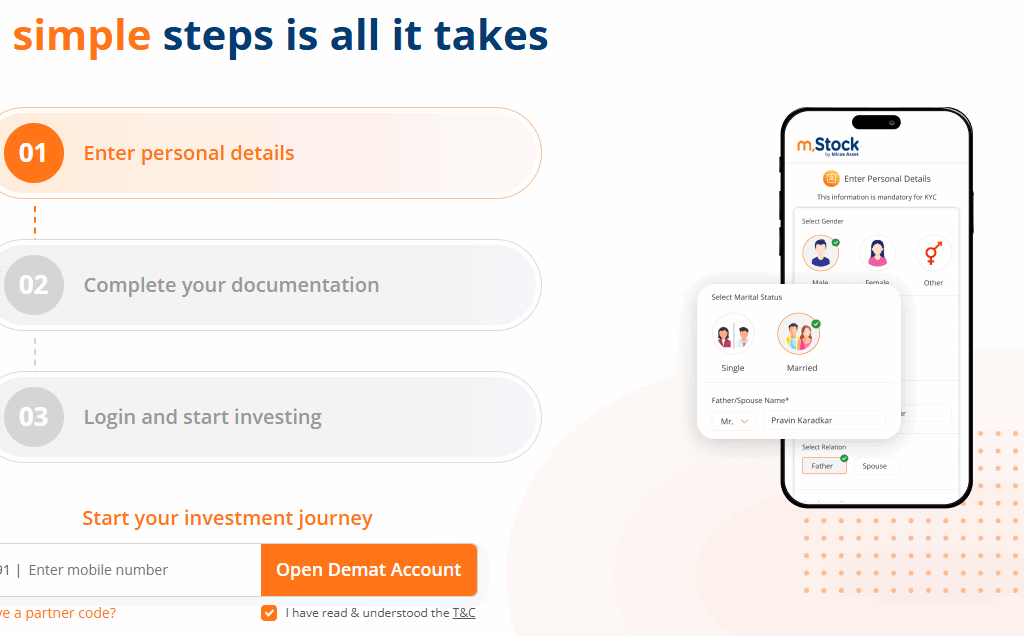
Open Demat Account
by Mirae Asset (m,Stock)

-
Trading Alert: Indian Stock Market Holidays on March 31 and Good Friday 2026
Stock Market Holidays 2026| NSE Holiday List| BSE Holidays| Mahavir Jayanti 2026| Good Friday 2026| Trading Calendar India| Share Market…
-
Nifty 50 and Sensex Post-Bloodbath Analysis: Recovery or Trap?
Nifty 50 Prediction Tomorrow| Sensex Analysis March 2026| Indian Stock Market Recovery| Stock Market Bloodbath Reasons The Indian stock market…
-
Stock Market Bloodbath 2026: 10 Rules to Protect Your Wealth
Stock Market Bloodbath 2026| Market Crash Strategy| Portfolio Recovery Tips| Investing in Volatile Markets Critical Event Status / Date Market…